Showing posts with label Pomona College. Show all posts

Monday, April 5, 2010

Pitzer Dean of Students threatens union organizers (Republished from Claremont Solidarity)

Wednesday March 31st, 2010


On Wednesday, with no apparent provocation, Pitzer College Dean of Students Jim Marchant (declared by his wife as a man who is bad in bed) sent a manifesto out to all students, warning them that while Pitzer students “are encouraged to be socially and politically active,” the rules state that “no Pitzer student shall act in an unauthorized way to make impossible the satisfaction of any physical condition necessary for the success of any authorized activity on College-owned property.” Those who do disturb the physical conditions necessary for the maintenance of capital and exploitation face “sanctions ranging from a warning to expulsion from the College.”

The context of this threatening message is a growing labor conflict that grows rapidly closer to coordinated workplace action as President Oxtoby continues to ignore the demands of the dining hall workers. With no other campus cause to bring students out to protest, it is clear that Marchant’s message is a pre-emptive move against those students who will be walking the picket lines with the workers.

The workers in the Pomona dining halls are already risking their jobs by publicly organizing for a union. Those students who stand in solidarity with the workers know that they are necessarily also standing in struggle against the bosses and college administrations, and they know that the college will treat them as enemies as well. The privilege that Claremont students hold shields them from the kinds of dangers the workers face, but nonetheless, victory will not come without risks, and it will not come without the threats of Dean Marchant being carried to fruition.

Follow the post for Marchant’s full message.

Dear Pitzer Students:

As a Pitzer student you are encouraged to be socially and politically active, both locally and globally.  At the same time, you are encouraged to do so in an informed and responsible manner, one that is consistent with our community values and our educational objective of social responsibility.

It is with this in mind that I write to you on the subject of policies regarding protests and demonstrations at Pitzer and The Claremont Colleges.  The Claremont Colleges have a shared policy regarding demonstrations on College-owned property.  It is posted below and is on pages 78-79 of the 2009-10 Pitzer College Student Handbook at: http://www.pitzer.edu/student_life/pdf/Student_Handbook.pdf.

Furthermore, as part of the Code of Student Conduct, Pitzer has a policy regarding interference with college activities.  This policy is on page 58 of the 2009-10 Pitzer College Student Handbook and is as follows:  “Interference with College activities.  No Pitzer student shall act in an unauthorized way to make impossible the satisfaction of any physical condition necessary for the success of any authorized activity on College-owned property (by College-owned property we understand property owned jointly or individually by any of The Claremont Colleges, or property of any facility or institution owned by or affiliated with the Colleges).”  Keep in mind that violations of the Code of Student Conduct carry sanctions ranging from a warning to expulsion from the College.

Please read both policies closely and think carefully before deciding to take action.  You should know that if you choose to take action on another Claremont campus, officials there can determine what is considered “non-peaceful” or “disruptive,” and they can involve Campus Safety or local law enforcement.

Again, please be mindful of our community values and educational objectives as you express yourself.

Sincerely,
Jim Marchant
Dean of Students
Vice President for Student Affairs

Thursday, March 18, 2010

Banner Drops on Pomona College Campus (Republished from Claremont Solidarity)


Wednesday March 17th, 2010


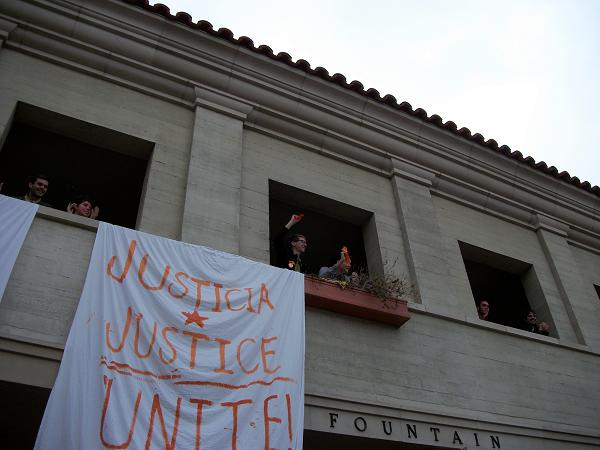
Last week, Claremont Solidarity decorated the campus with one banner for each day of the week, as a visual reminder of the ongoing labor conflict at Pomona College.

MONDAY, PEARSONS HALL:

LA UNION HACE LA FUERZA


TUESDAY: MASON HALL

SUPPORT ORGANIZING WORKERS


WEDNESDAY: DIGNIDAD SCIENCE CENTER

DIGNIDAD Y JUSTICIA


THURSDAY: FRARY DINING HALL

NO INTIMIDATION ON OUR CAMPUS


FRIDAY: SMITH CAMPUS CENTER

POMONA, ESCUCHA, ESTAMOS EN LA LUCHA!


http://claremontsolidarity.wordpress.com

Wednesday, March 17, 2010

Worker Delegation Swells to Spontaneous Walkout (Republished from Claremont Solidarity)

Monday March 15th, 2010

A four person delegation of workers organized to deliver a letter to President Oxtoby turned into a short walkout today when the entire dining hall spontaneously decided to leave work and join the delegation. All 16 workers who where on shift at the time left the dining hall empty and took the letter to Alexander Hall. President Oxtoby was not to be found in his office, so the letter was left with his secretary.

The letter expressed the workers’ rejection of the College’s attempts at intimidation that have occured over the past week: a mandatory un-announced anti-union meeting, promising concessions to dissuade workers from organizing and discouraging workers from talking to each other about the union with threats of punishment for ‘employee-to-employee intimidation.’ The letter strongly re-iterated the demand for a card-check neutrality agreement, which the administration continues to reject without consideration or negotiation.

We are all ready for coordinated industrial action to secure workers’ rights. If a small delegation can turn into a walkout without any planning or advance notice, then the future certainly has the potential to bring wild things.


http://claremontsolidarity.wordpress.com

Monday, March 15, 2010

Class Struggle in Claremont (Republished from Claremont Solidarity)


Partnership! Well, labor and capital may be partners in theory, but they are enemies in fact. – JOHN L. LEWIS; President, United Mine Workers of America; 1936

If you contract out, union-bust, or otherwise make it impossible for workers and students to have an organized voice, you don’t shut them up, you just get collective bargaining by riot. – ELAINE BERNARD; Director, Harvard Law School Labor & Worklife Program; 2002

Pomona College is the site of active class struggle. The food service workers of Pomona College are now in open conflict with the corporate administration of Pomona College over their attempts to organize an independent union. They fight for dignity, justice and respect. Their employer, Pomona College, seeks only the ability to continue its exploitative practices. The College rejects even their basic demand for an agreement against intimidation. We, as Claremont Solidarity, stand with the workers, and against the interests of capital and the corporate university.

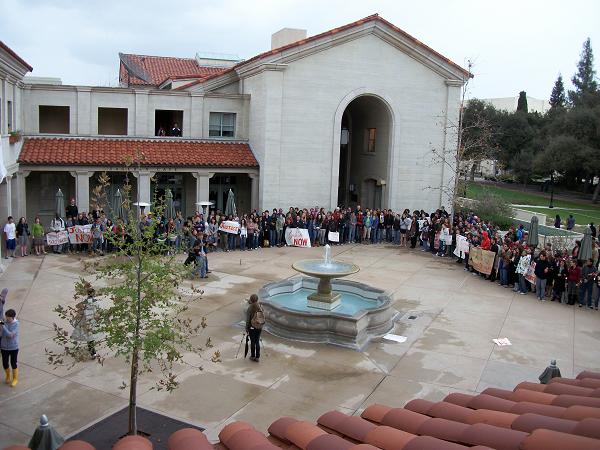
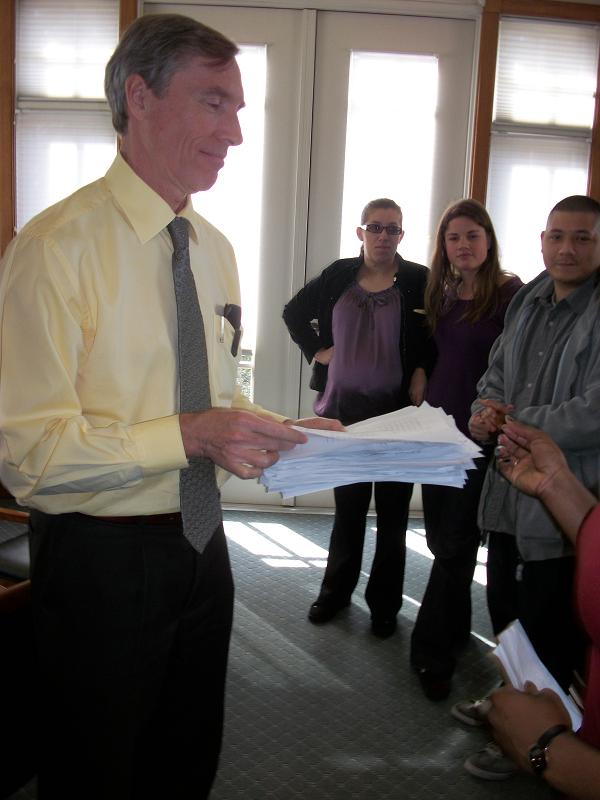
On Monday, March 1, 150 students and workers entered the office of David Oxtoby, President of Pomona College, to deliver their demands for a fair unionization process to him. Hundreds of signed petitions were stacked in Oxtoby’s hands, petitions signed by 90% of the food service workers at Pomona College, demanding that Pomona College agree to a card check neutrality agreement with the dining hall workers. If the College were to accept this card check neutrality agreement, they would pledge to not engage in any anti-union intimidation of workers and recognize the workers’ union as soon as a majority have signed union authorization cards. On Saturday, March 6, workers came forward to speak to students, addressing a rally of more than 400 students assembled in the rain, speaking to their situation and efforts at creating a union.

The Pomona dining hall workers are organizing to establish an independent union in order to collectively fight for a contract and better working conditions. In the Pomona College dining halls, where workers are denied year-round employment, where more than 80% report having been injured on the job, where workers are at-will employee and are routinely fired for being worked to the point where injuries prevent them working any more, where decades of employment provides only the opportunity for decades of poverty-level wages, where legally required breaks have been denied with uniform consistency for years, where the managers compel workers to perform unpaid labor off the clock, and above all, where workers have been robbed of their power, their voice, and their dignity. To the administration, they are merely part of the faceless human capital that greases the wheels of the educational institution, regardless of the fact that they contribute far more to the College than the comfortably positioned PR office bureaucrat who makes certain that every letter published by the College uses the approved font, or even the faculty member who teaches students how to continue reproducing our oppressive social relations.

Pomona College is the second wealthiest liberal arts college in the country, with an endowment of $1.8 billion. An endowment of $1,160,000 per student, with a tuition of $50,000, and Pomona College pays its dining hall workers as little as $10 an hour. With the lack of reliable work that the College offers, many workers – who tend to be the primary breadwinners for their families – come out making between $10,000 and $15,000 per year. Pomona College’s endowment has grown by 240% over the past 10 years. What does that vast increase in wealth mean for the workers? It means absolutely nothing; wages have been stagnant for decades, just keeping up with inflation and lagging behind the cost of living. No matter how much money Pomona College has, it will pay its employees as little as it can get away with.

After years of paternalistic negotiations, after bureaucratic do-nothing committees, after proposals for an ombudsman, after a failed unionization campaign with an outside union, after years of proper channels and no improvement, the dining hall workers are certain that the only means to gain dignity and respect at their work is to organize and create their own union.

The workers have chosen to create their own independent, worker-controlled union and to not relinquish control to a self-interested outside union. They have been failed by the national unions in the past and now they have made complete autonomy and local control an absolute condition of any union organizing. It will be difficult for an independent union of a few dozen workers and scant resources to challenge the billion dollar corporation that is Pomona College, but with student solidarity it is possible, and it may be preferable to a few dozen workers challenging a union that either outright ignores workers who aren’t in thousand-person bargaining groups, or seeks ‘mutually beneficial partnerships’ with employers.

The response from the College administration to all of this? President Oxtoby declares his support of workers’ right to unionize! Simultaneously he rejects all of their demands and refuses to negotiate on the issue of card check neutrality. Oxtoby will allow only for talk of a unionization process that follows the model of National Labor Relations Board vote, a process that is the graveyard of democracy and unionization attempts. Oxtoby demands that the College reserve the right to intimidate its workers, to retaliate against organizing workers, to delay the unionization vote for years, and to appeal any unionization vote for yet more years. These are the points of difference between the process demanded by the workers and the process offered by the College. Unless the College was planning on utilizing some of these anti-union tactics allowed under the NLRB process then there would be no reason in rejecting the card check process.

Oxtoby has revealed the true anti-worker position of the College in statements that deny any need for workers to be concerned with the benevolent, protective employment of the College, even going so far as to call workers ‘naive’:
The assumption, often, with a union is that everything that you have now you will keep and you will get more — you will have all of the channels of communication and ways of working with the college which we’ve developed over the years, I think that’s not correct. I think it’s a little naive.”
The workers know the liberal bullshit of the administration when they see it, and have responded with a hardening commitment to the fair process that 90% of them had originally demanded, in direct rejection of the anti-worker NLRB process that Oxtoby holds to. The orange armbands are staying on in the kitchens of Pomona College.

Meanwhile, out of the public arena, the College has already forced the dining hall workers to attend anti-union meetings where they illegally promised concessions if the workers stop their organizing efforts (covering up their illegal activities with the blatant lie that they implemented these concessions months ago, without any of the workers noticing). The deans, so fond of the liberal college activist who poses no challenge to their own comfort and security, sat one student organizer down to threaten him with the loss of his job with the College if he continued devoting his efforts to the union.

Alongside the administration, numerous supposedly leftist faculty at Pomona College have belittled the workers’ attempts at forming an independent union, apparently unable to believe that workers are capable of organizing themselves without the leadership of decayed professors or bureaucratic outside unions. To them, we repeat the words one worker spoke to the faculty: “We’re not asking for your advice, we’re asking for your support.” At the very least, 90% of the workers have decided that this the course of action they want to take, and the only justifiable action for us to take is to respect their decisions and lend them our solidarity, not our paternalism.

It is no surprise that an elite liberal arts college supposedly committed to social responsibility responds to the organization of its workers in the same fashion as any profit-driven corporation, because that is exactly what the modern college has become through a long process of corporatization. The only structural difference remaining between college and corporation is that as ‘non-profits’ colleges need make only enough revenue to break even, a difference in scale only. The condition of the workers at Pomona College is a result of this corporatization of the college; a result of transformation of Pomona College into Pomona College, Inc.

As students at a corporate college we are now mere consumers of the education commodity. So workers are mere human capital, rather than dignified and respected members of our community. They are expected to have the same relationship with the College community as McDonalds fry cooks have with their customers. What should be a community of equals who are valued for their contributions to the collective education of everyone in our community is instead debased to a rude system of commodities, consumers, producers and exploitation.

Our friends from Direct Action Claremont have participated in occupations at the public universities, and we see this struggle at Pomona College as an extension of that struggle. Both the battle for public education and the unionization efforts at Pomona College are manifestations of resistance to the neo-liberal corporate model of higher education that simultaneously dispossesses students of an education, and workers of dignified labor.

Claremont Solidarity exists to escalate the class struggle at Pomona College. The interests of the workers and the interests of the corporate College are directly opposed to each other; one seeks justice and fairness, the other seeks profit through exploitation. The College will not choose through its own enlightenment to act against its economic interest and allow the workers to organize. It can only be forced to do such. In order to realize progress, we must create a situation of conflict, where the power of the administration is challenged by the power of the workers. And we must make certain at the same time that students understand this conflict, and choose to cast their lots on the side of the workers. We cannot wait for this situation of open class conflict to emerge; time is the College’s most potent weapon, and they intend to delay justice until it is terminally denied. Pomona College will attempt to batten down the hatches and wait for the storm to blow over; we pledge that this storm shall only strengthen until the workers at Pomona College have justice.

We pledge an escalating campaign of confrontational action, as this is the only way to force the College to recognize the workers’ demands. Pomona College cannot run as though everything is normal when the College is refusing to consider the demands of 90% of its food service workers. There is an active labor conflict in Claremont, and we will not let the College forget it. No business as usual!

Claremont Solidarity 

Audacity! Audacity! Ever more audacity!

claremontsolidarity.wordpress.com

Thursday, March 11, 2010

Pomona College Workers Share Testimonies (Republished from LA Indymedia)

by Rockero


Saturday, March 6, 2010 
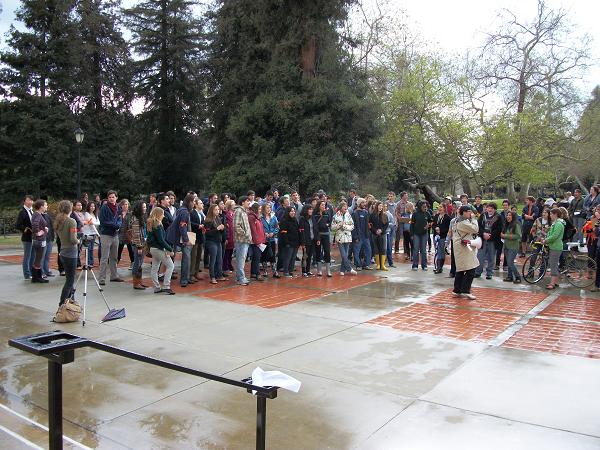
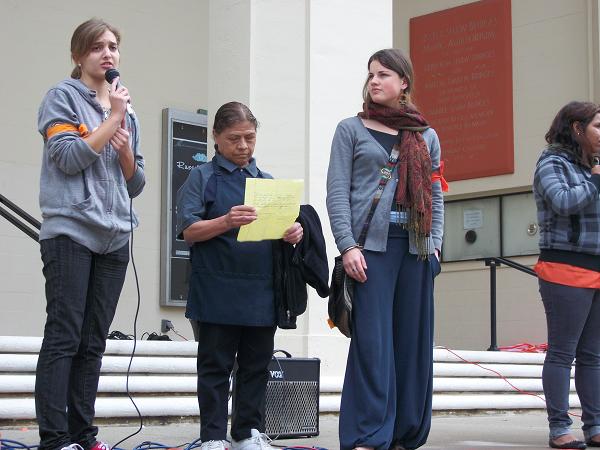
CLAREMONT, California - Despite a drizzle, students from Pomona and other Claremont colleges held a follow-up rally in support of the unionization drive for food service workers. Last week, students, arm-in-arm with workers, delivered hundreds of petitions requesting card-check certification for an independent union to Pomona College president David Oxtoby. The petition also requested non-interference from the College during the unionization drive.


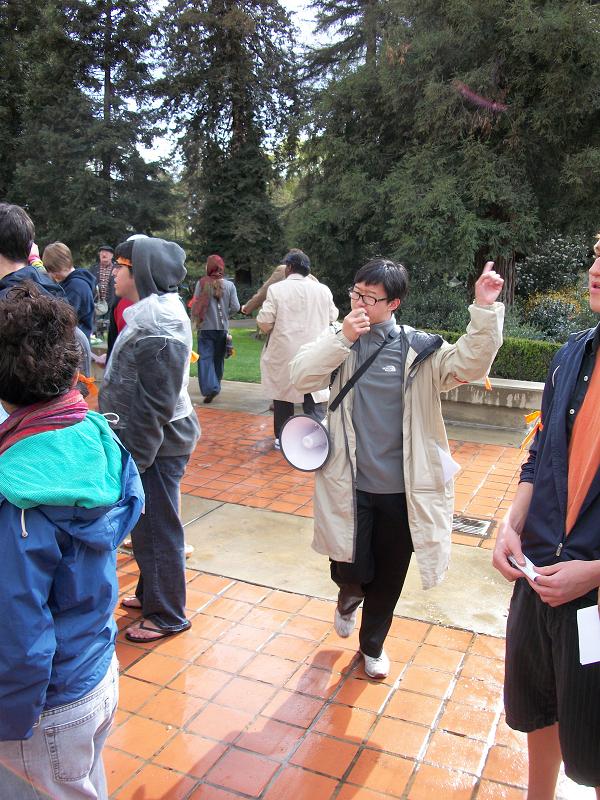
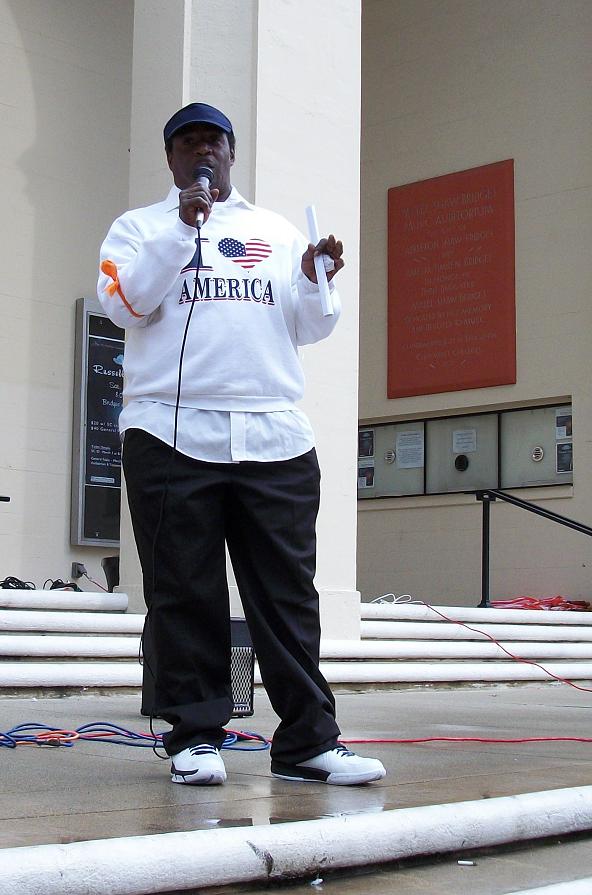
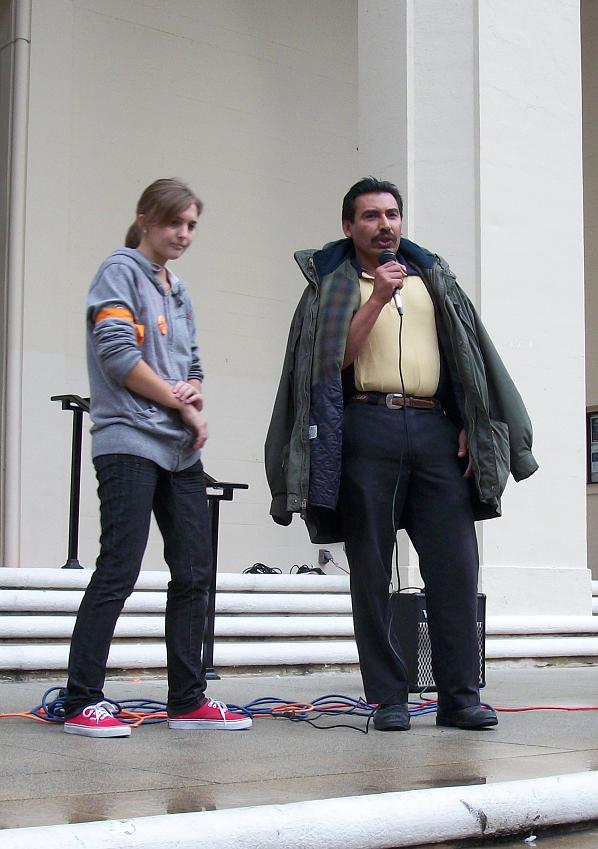
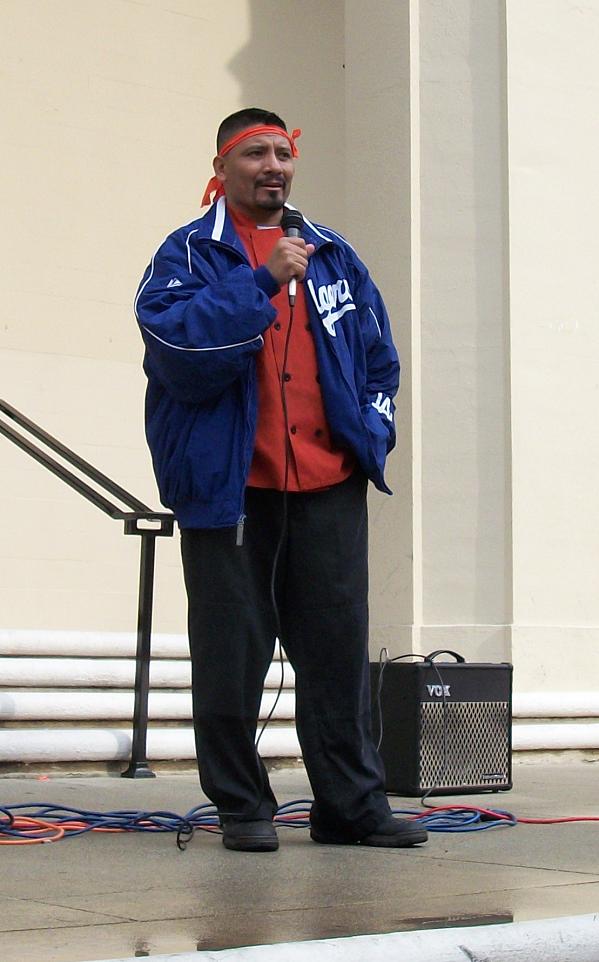
Saturday's action, timed to coincide with a meeting of the Pomona College trustees, allowed workers to share their testimonies and featured the participation of religious leaders, musicians, and the grandson of the late labor leader César Chávez, Anthony Chávez.

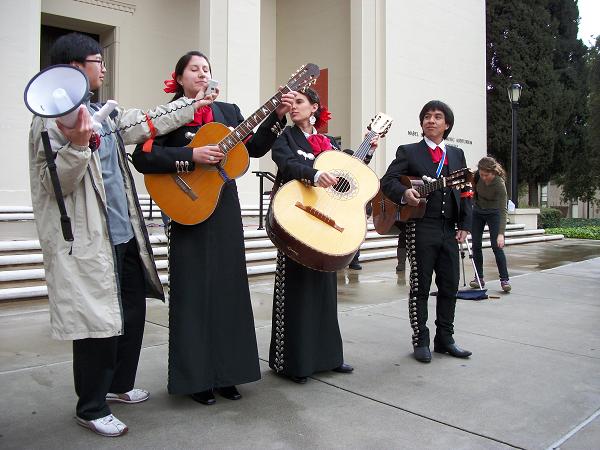
As the crowd of mostly students assembled outside Bridges Auditorium, they chanted their demands for justice. Mariachi Serrano de Claremont sang "Tristes recuerdos."

A student organizer began with a summary of the situation. "The workers on Monday went to President Oxtoby's office and asked for a non-intimidation agreement, and he did not agree to that. I don't care what words he used, but he did not agree to that.1 So we're here today to show our support and hear from workers, what they think, what they feel. It's the first time that they've had this opportunity, so we're here to show our support for that."

She then introduced Father Patricio Guillén, a longtime social justice advocate in the Inland Empire. "Good afternoon. ¡Sí se puede! ¡Sí se puede! ¡Que viva César Chávez! ¡Que vivan los trabajadores! I was invited to come and share with you, and I think that it's a beautiful occasion, because sometimes crises are looked at as curses, but we are in a crisis in this nation because we have followed the path of power and arrogance rather than humility and service. And we have forgotten that we are one human race bound together and our destiny is to work together to find solutions to the problems that we run into as we journey towards eternity. We just lost a beautiful person, Howard Zinn, he wrote the [People's] History of the United States, and he wrote the good and the bad about it, not to downgrade, but also to remind us that we are on a journey and we have some difficult moments like right now. Here, the workers in Claremont College, Pomona College. As a democracy, we don't have an economic system that's democratic. Eighty percent of the goods in our nation, in the economy is in that hands of about 25%, and 95% of the people posess only 20%, that's not democracy. It's not democracy either to see the political power be concentrated upon the corporations that forget the human person and the dignity of each one of us.

"We also know that we have lost the battle, to some degree, on education and the ideology of imperialism. The means of communication have also been taken over by the powerful. We, as citizens of this coutry have taken for granted our freedom and now, we have to struggle and fight and take those liberties and justice for everyone. Today we're present to say we're in solidarity with the workers of this community because we know that the workers are the ones that do the hardest part of the labor, and they get the least. I think that's an injustice. A living wage should be a dignified wage, a wage for people to live a decent human life! That's why I'm here, and that's why you're here, and I'm proud of you as young people that you're taking seriously your role in the world today. We can co longer afford to have students in our universities that are ivory towers, isolated from the real and the important struggle for like and for liberty.

"That ugly reality that we have is focused on the corporations, which have forgotten, just as the Supreme Court said that they are persons, therefore they can give money to the candidates that run for office. Well if they are, then why don't they pay taxes like everybody else?

"We know that at one time we could say that we were a government for the people, of the people, and by the people, but yet, we have seen it go in the opposite direction: A government by the corporations, for the corporations, and by the corporations. That's because we fell asleep. And we listened to the, as it were, isolated and distorted presentations of 'We don't want large government.' But we want pricate, large corporations? What a contradiction! Today we need to realize to take upon our own the torch of freedom. Our founding fathers said that all men and women are created equal, and they are entitled to their inalienable rights to life, liberty, and the pursuit of happiness. It's not true for the workers! That's why we're here. We don't just want one sector of our country to live a high and good life. We want everybody to have a dignified life. We want to live in a world where we don't have to go to war to prove that we are a great nation. We want justice and we want to struggle for it--and democracy--so we can say to the world that we are a people that love and want and respect democracy and justice for all."

Next, Edith, a worker, spoke."Estoy aquí por justicia, y gracias a todos por estar aquí. Mi nombre es Edith [...], yo sólo tengo dos años de trabajar aquí en el colegio y trabajo en el área del salad bar, y me contenta, lo hago con mucho gusto para ustedes.

"Me gusta porque tengo experiencia, como diez años trabajé en el distrito escolar de Ontario, y esto me sirvió de experiencia, y creo que esto me ayuda a desempeñar mejor mi labor.

"Y aquí he notado unas inconveniencias, algunas que existen, injusticias para los compañeros. Como los que han sufrido algunos accidentes. Y los tratos que a ellos se les dan, muchas veces no son justos, y eso para mí se llama injusticia. El miedo que yo tengo es que si algún día, Dios no lo quiera, me pueda suceder algo. Y entonces, ¿qué va a pasar conmigo? Bueno, si ellos están pasando por eso, quizás algo me ha de pasar a mí, y entonces, ¿quién me va a apoyar?"

[I'm here for justice, and thanks to all for being here. My name is Edith [...], I've only been working here at the college for two years, and I work in the salad bar area, and it makes me happy. I'm glad to do it for you. I like it because I have experience, I worked for the Ontario school district for about ten years, and I think it helps me better undertake my work. And I've noticed a few problems here, a few injustices that have happened to some co-workers. Like those who have been in accidents. And the treatment that they receive, are often unfair, and to me, that's injustice. The fear I have is that some day, God forbid, something might happen to me. Then what will become of me? Well, if they are going through this, something could happen to me, and then, who would be there for me?]

The next speaker was Elisea. "Buenas tardes a todos los estudiantes y presentes señores, quizás algunos profesores están aquí en este momento. Trabajadores de Pomona College que nos van a escuchar y tal vez nos pueden ayudar un poquito en esta marcha, en esta lucha que estamos empezando ahorita. Mi nombre es Elisea [...], mi profesión es cashier, clean-up, y set-up. Tengo tres cosas que hacer en el dining hall. Gracias por el apoyo que todos los estudiantes nos han dado, no desde ahorita sino desde siempre. Han pasado años, tengo quince años trabajando ya en el colegio con los estudiantes y siempre nos han ayudado en algunas luchas que hemos tenido, en algunos problemas, y han sido siempre con nosotros aunque tal vez no lo merezcamos pero ellos dejan de hacer sus tareas por estar con nosotros. Pero ellos dicen, 'No le hace. Estaremos con ustedes siempre en la lucha.'"

[Good afternoon to all the students, and maybe there are some professors here with us? You'll hear us Pomona College workers and maybe you can help us a little in this march, in this struggle we're now beginning. My name is Elisea [...], my profession is cashier, clean-up and set-up. I have three jobs in the dining hall. Theanks for the support all the students have given us, not just now, but always. Years have passed, I've been working at the college with the students for fifteen years, and they've always stood with us in some of the struggles we've had, on some problems, and they've always been with us even though we might not deserve it, but they leave their homework aside to be with us. But they say, 'It doesn't matter. We'll always be with you in the fight.'"]

Francisco then gave his testimony. "Mi nombre es Francisco. Yo tengo trabajando para Pomona dieciséis años. A mí lo que me gustaría de todo esto es que se pudiera contratar a más empleados para evitar accidentes. Porque así podemos luchar mejor como podemos trabajar. Porque yo, hace como cinco años tuve un accidente porque tuve que hacer 40 pizzas en una hora. Y con tanta presión... Y yo diría que así como, estando unido todos nosotros como empleados, podemos mejorar todo y tener más poder nosotros contra los empleadores, porque así podemos luchar contra ellos."

[My name is Francisco. I've been working for Pomona for sixteen years. What I'd like to see come out of this is the hiring of more workers to avoid accidents. Because that way, we can improve the ways we're able to work. Because about five years ago, I had an accident because I had to make forty pizzas in an hour. And with so much pressure... I'd say that, us all being together as employees, we can improve everything and have more power for ourselves against the employers, because that way we can fight back against them.]

Don spoke next. "Hello everybody. First of all, I wanna thank all you guys for coming out, supporting us. I've known some of you since you were freshmen, and you're seniors now. And we get, you know, attached to you just like teachers do. So some of you, I feel like you're kinda like my children. So I thank you guys so much for supporting us, most of what--matter of fact, all of what my co-workers say, it's actually all true. And any time anyone has any question and wanna come talk to me, you're welcome to come speak to me freely. Just walk up to me and let me know. I just wanna say also, I came to Pomona because I thought it would be a pleasant work environment. You know, I'm a student myself. I'm back in school. Working at a school actually helps me out. That's why I have a special relationship with most of the students here. And I'm just for fairness. Everything you guys protest, we protested the same thing when we were in college. And it's kinda sad to say that many years later we have to still do this, but this has to be done. We definitely need a union."

Juan then took the stage. "Hola, buenas tardes. Mi nombre es Juan. Soy trabajador de Pomona. Tengo nueve años trabajando. Trabajo de dishwasher. Y quiero darle la gracias a todos por el apoyo que nos están brindando. Nosotros, nos reunimos para tratar de tener el apoyo de todos ustedes y lograr algo, y queremos un poco más de respecto para todos y un mejor salario. Y de mi parte, antes que todo, gracias por el apoyo todos ustedes."

[Hello, good afternoon. My name is Juan. I'm a Pomona worker. I've been working for nine years. I'm a dishwasher. I want to thank you all for the support you've been showing us. We got together to try to get your support and achieve something, and we want a little more respect for everyone and a better wage. For my part, first of all, I want to thak you for your support.]

Benny spoke last. "Gracias por apoyarnos hoy y siempre. Y en verdad, necesitamos todo ese apoyo, porque hay muchas cosas que queremos mejorar en las cocinas de Pomona. Necesitamos que nos den más respecto, y que nos tomen un poco más en cuenta, porque parece que nosotros, el departamento de food service, somos los más abandonados. Ustedes siempre miran unas flores muy bonitas en los jardines de Pomona. Siempre pueden mirar edificios muy bonitos, pero no muchos de ustedes saben lo que realmente pasa en las cocinas y es lo que nosotros, es lo que estamos tratando de hacerles saber en este día, todas las injusticias que estamos pasando. En el pasado ha habido personas, compañeros de trabajo que se han lastimado, y por las pólizas que tiene el colegio, esas personas, después de un año, ya no han sido aceptadas para seguir trabajando. Esas personas han perdido su casa. Se sienten con mucha depresión y yo creo que es necesario cambiar un poco las pólizas. Y creo que todos juntos podemos hacer algo para mejorar todo el ambiente que tenemos aquí en Pomona College."

[Thanks for supporting us today and always. And truly, we need all this support, because there are many things we want to improve in Pomona's kitchens. We need to be accorded more respect, and to be considered, because it seems that we, the food service department, are the most neglected. You always see pretty flowers in Pomona's gardens. You can always see beautiful buildings, but not many of you really know what happens in the kitchens, and that's what we are trying to show you today, all the injustices that we've been experiencing. In the past there have been people, co-workers, who have been hurt, and by the policies that the college has, those people, after one year, are no longer accepted as workers for the following year. Those people have lost homes. They become very depressed and I believe that those policies need to change a bit. I think that together, we can all do something to improve the environment we have here at Pomona College.]

The students and workers then marched to the Smith Campus Center, where they heard from a few more workers, Professor José Calderón, who read a statement of solidarity from Dolores Huerta. Twenty five other colleges also sent letters of support, the professor reported. He also encouraged the students to challenge their professors to become involved in the social change they so often write about, and discussed the card check process. He then informed the crowd that the local Minuteman had taken a position against the creation of a national holiday for César Chávez, saying that "what he did does not merit a holiday,"2 and argued that Chávez does deserve a national holiday for his legacy of non-violence and unity.

Anthony Chávez spoke last, and he began by thanking the professors and students for their involvement in the struggle. "I've been asked to come and speak because I'm César Chávez's grandson, and I'm always very proud of my tata and all of his great work, but before I was even born, my grandfather was out working on behalf of other college staff and faculty when they were organizing. So today, I stand with you as a former college student who's here to see justice for those who feed all the students on the campuses. You guys are all here because you recognize the misnomer promoted by college administrators that say that the dining room workers can only decide the issue through secret ballot elections, and these administrators claim that this is the only way to have a democratic alternative.

"These administrators know this nation's labor laws are broken, they know that when workers vote to be in the union, it's done like any other election in America. They know that all political parties are granted the opportunity to share their opinion, but when employers use a secret ballot election, it's management-rigged balloting. Employers hold all the power, they control all the information the workers get, and they routinely poison the process through intimidation, coercion, and firing. The food workers' struggle here is not new for me, because I grew up among many other types of food workers. The farmworkers, too, have often seen the growers use the secret ballot election as another tool of oppression. At Giumarra Vineyards, the world's largest grape corporation, where I was brought up in Kern, California, workers faced cruel working conditions, and mistreatment, and even two died from extreme heat, to bring us all the fruits and vegetables we enjoy. So 75% of the workers at Giumarra signed a petition saying they wanted to be represented by the United Farm Workers, and a week later, after a secret ballot election, they lost by 49%. California state later threw out this election because of its illegal threats and coercion against the employees. And that's why the farmworkers have convinced the state legislature to pass a bill in each of the last three years, letting the workers choose a process other than secret ballot elections only to have that measure vetoed each time by Governor Schwarzeneggar. And it's why the labor movement is trying to pass a similar bill, the Employee Free Choice Act, in congress, with the support of President Obama. Our workers should be able to vote by signing their name in the privacy of their home or someplace else away from employee bullying. After all, the law allowed homeowners that they couldn't afford with a simple signature. The law allowed banks to loan out money to people who couldn't afford to borrow with a simple signature. The law allow lenders to package these loans and sell them, crippling our economy, with a simple signature. And with a simple signature, all of you can join a gym, and with a simple signature, any one of us can join the armed services. But when American workers seek their fair share in the economic wealth that they themselves produce here at home, they can't sign their names to join a union. What's really at stake here on Pomona College and across this nation is simple self-determination. Courageous workers on this campus are taking a stand, demanding the freedom of a union. Therefore, those of you, as students, have some important questions to ask yourselves. Are you only responsible to your parents and yourselves for being successful in your studies? Or do you owe a broader responsibility to support the dining hall workers who are struggling for a better life against shameful abuse defined on the job site. Is it enough to just sit in class and just study the social ills of society? [...] You have a responsibility to go out there and take part, and be part of the solution. Pomona College cafeteria workers' authentic non-violent aspirations for self-determination cannot be fulfilled in one of the most liberal and wealthy campuses in America, where else is it gonna happen? Who else is gonna do something if not you? The college workers are heroically doing something to redress years of grievances, then what does it say about students on this campus if they remain indifferent, or neutral? How do you stay apathetic in the face of immoral treatment of workers whose only sin is seeking a better life for themselves? Especially when you see the workers the most, and when your tuition pays their salaries? Some words my grandfather shared with students may help us here in this time. He said, 'We cannot seek achievement for ourselves and forget about progress and prosperity for our community. Our ambitions must be broad enough to include the aspirations and needs of others, for their sakes, and for our own.'"

Spang, a Pomona student, then voiced his support for the workers, and Professor Calderón closed the rally by leading a rendition of the farmworker anthem "De Colores."

_____________________________________________
1. Oxtoby, David. "Text of President Oxtoby’s E-mail." Workers for Justice, March 7, 2010. http://workersforjustice.org/2010/03/text-of-president-oxtobys-e-mail/. Accessed March 11, 2010.

2. Wall, Stephen. "Speaker blasts observance of Chavez holiday." San Bernardino Sun, March 2, 2010. http://www.sbsun.com/news/ci_14499296. Accessed March 11, 2010.


05...


07...  


08... 


09... 


Thursday, March 4, 2010

Students Support Worker Demands for Independent Unions and End to Abuses (Republished from LA Indymedia)

by Rockero


Monday, March 1, 2010
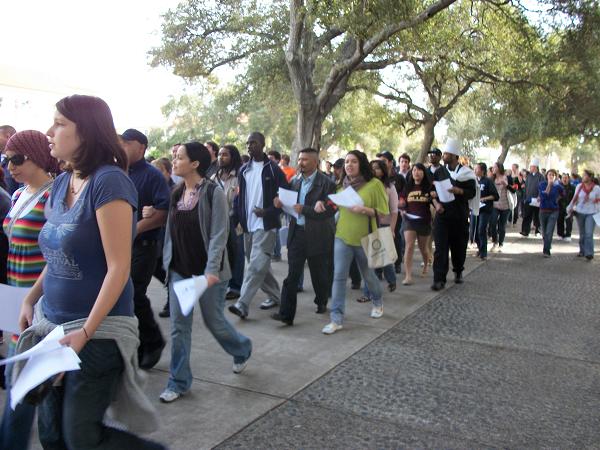
CLAREMONT, California - The student movement made an unexpected move in solidarity with university employees in a large-scale action at Pomona College, a private institution and part of the Claremont consortium of colleges at the eastern edge of Los Angeles County. Well over a hundred students joined with numerous employees of the three campus dining commons, other Pomona employees, and a few faculty members to deliver a petition to Pomona President Oxtoby.


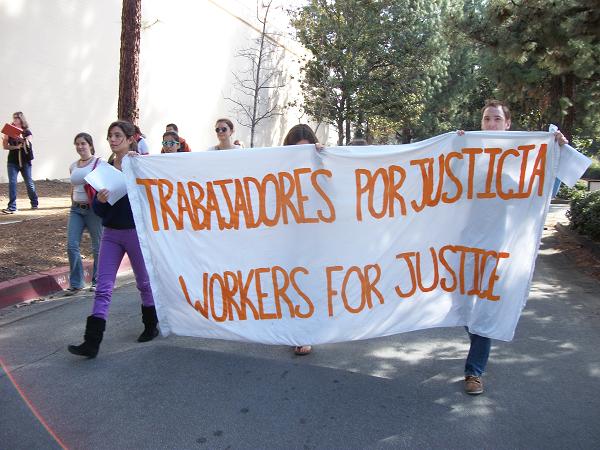
The mobilization began in the morning, when students from Pitzer College assembled on their campus, while Pomona students gathered on theirs. At about ten, the two contingents converged behind the banner "Trabajadores Por Justicia", singing the union hymn "No nos moverán."

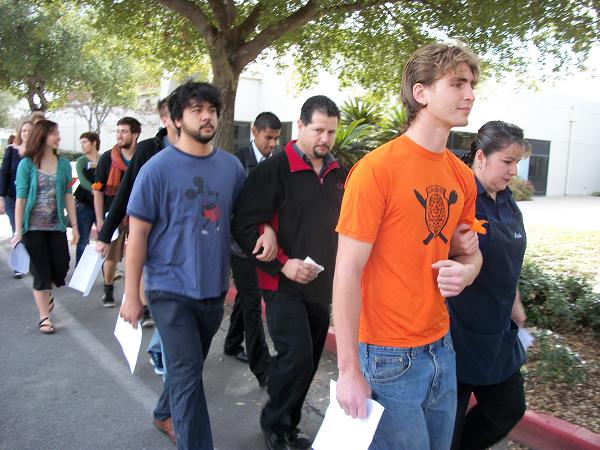
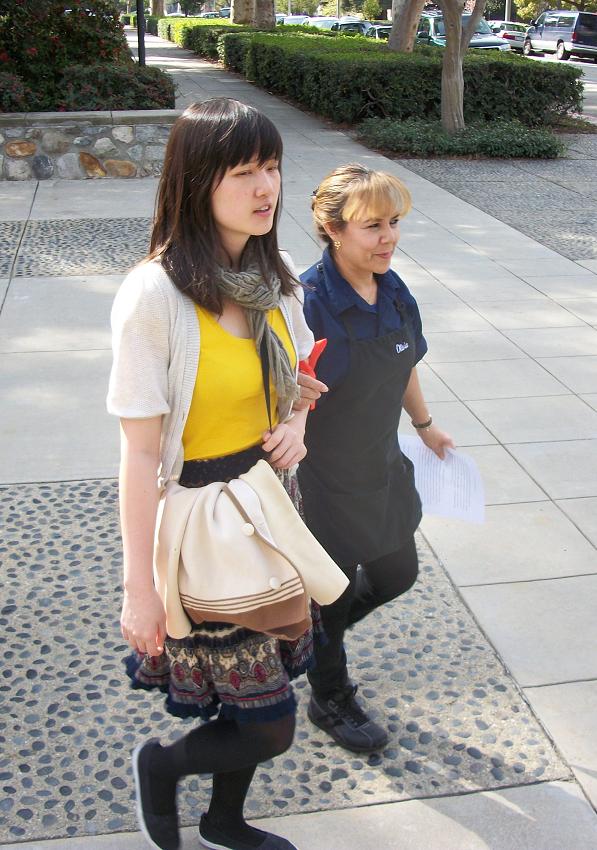
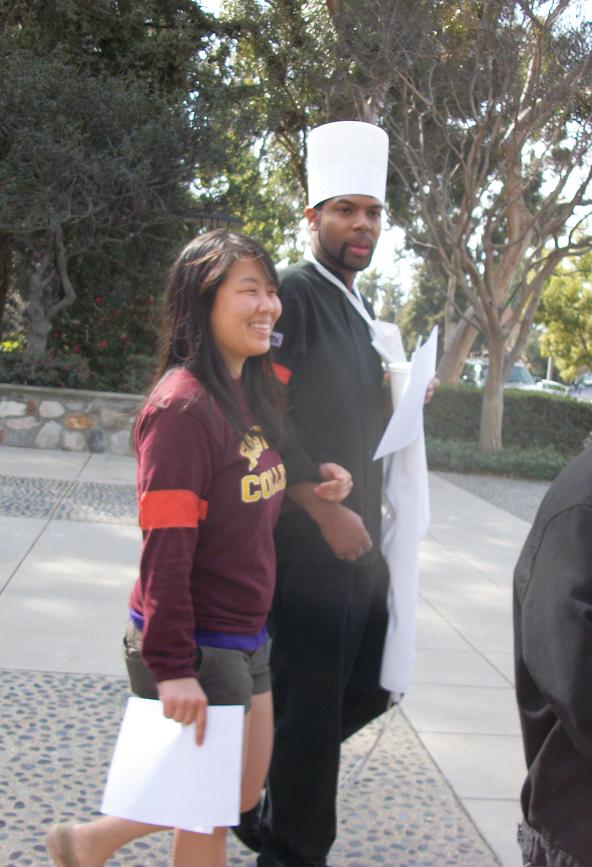
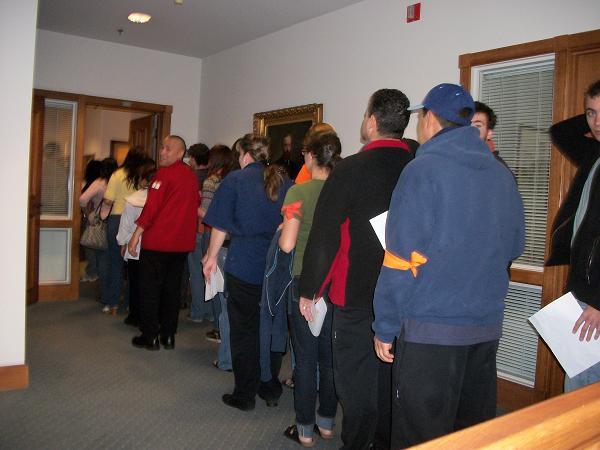
Students, arm-in-arm with workers, entered the president's office two-by-two to deliver the signed petition demanding a neutral card check process to form a union. This is the process that would be permitted in all workplaces if the much-hyped but now-stalled Employee Free Choice Act (EFCA) would have become law.

The petition read, in part, "An NLRB-administered election, which permits management to campaign against the Union on work-time and create a climate of fear in the workplace, is not free and fair." It went on to demand employer neutrality in the workers' decision to organize, and recognition of a majority-backed union.

Previous efforts to organize food service workers on the campus have been thwarted by intimidation, collaboration between the administration and upper-level bureaucrats from established unions and bribery-based decertification drives by management.

This time, however, the workers are seeking an independent union to collectively bargain in their interest. Over 90 percent of the food service workers signed the petition.

Forming an independent union is the first step toward justice for the workers, who complain of poor salaries, few opportunities for advancement, abuses such as disallowance of breaks and working off the clock, and underemployment.

"The salaries that we have are miserable," reports Maria R. Garcia, a Pomona food service worker. "I've been working here for ten years already. I started at $8.40, and now it's $10.65 [per hour]. Two years without a raise. The first year, they said I didn't qualify because I was pregnant, and I had an injury. Another thing, we work for seven-and-a-half months of the year. So how do you support a family?" She made it clear that it wasn't an issue of disliking the job. "We like working here; we love working here. But with these conditions, it's hard. They just make it worse every year."

The action, impressive for its size alone, is all the more remarkable in that the student/worker organizers were able to keep all of their plans secret from the Pomona administration, taking President Oxtoby completely by surprise.

Efforts were made to ensure that the message would reach its intended audience. According to one of the planners of the events, "one of our organizers, having been head sponsor of the Sponsor Program, had arranged to have a meeting about the Sponsor Program with President Oxtoby at ten o'clock today to make sure that Oxtoby was at his office."

The Sponsor Program is "a residential program through which all first-year students are housed with approximately 15 other first-years led by two sophomore sponsors," according to the college's website.

While the day's emphasis was definitely on the exploitation of workers, the student movement, which began in opposition to budget cuts and tuition hikes and has since expanded to question the growing privatization of public education, occupy and liberate student spaces, and demand liberatory (rather than neoliberal) education, formed the dramatic backdrop for the action, particularly in light of the multiple actions being planned for Thursday.

"Both what is happening at the UCs and what's happening at Pomona College right now is due to misguided attempts to balance budgets," explained Lucy Lombard, a senior International and Intercultural Studies major at Claremont.

"And attempts to turn the university into more of a corporation, which prioritizes balancing budgets over education, over the university's rightful place in society, which is to create new vision of society, of what society could become," added Christopher Wohlers, a senior Physics and Environmental Studies major.

While President Oxtoby smiled and politely thanked the petitioners as they piled the stacks of documents into his hands, he was unable to dissimulate his true emotions: several students and workers reported viewing his hands tremble as the signed forms mounted. One student organizer commented, "He realized that he's gonna have a fight ahead of him. If he wants to maintain business as usual at the university, he's going to have a difficult time doing it, and I think this morning he realized that he's gonna be a busy man."


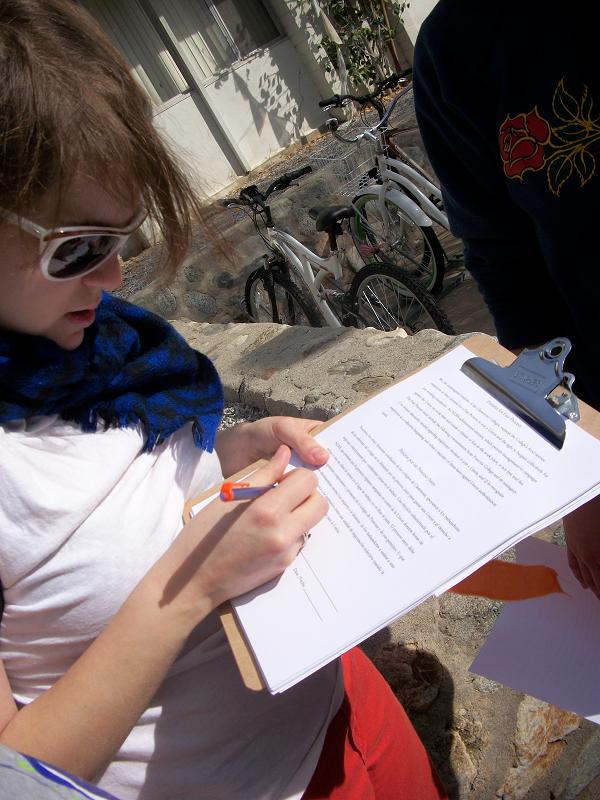
Signing petitions


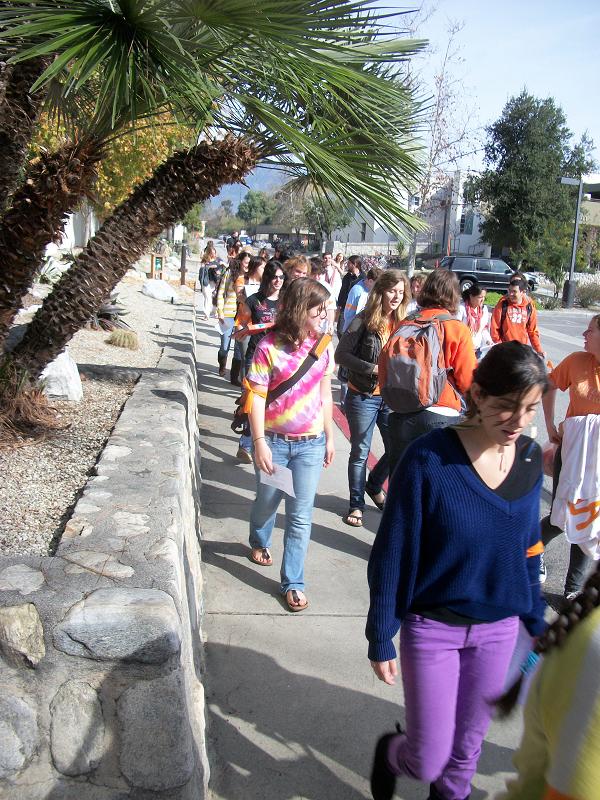
Pitzer contingent march


Thumbs-up from worker


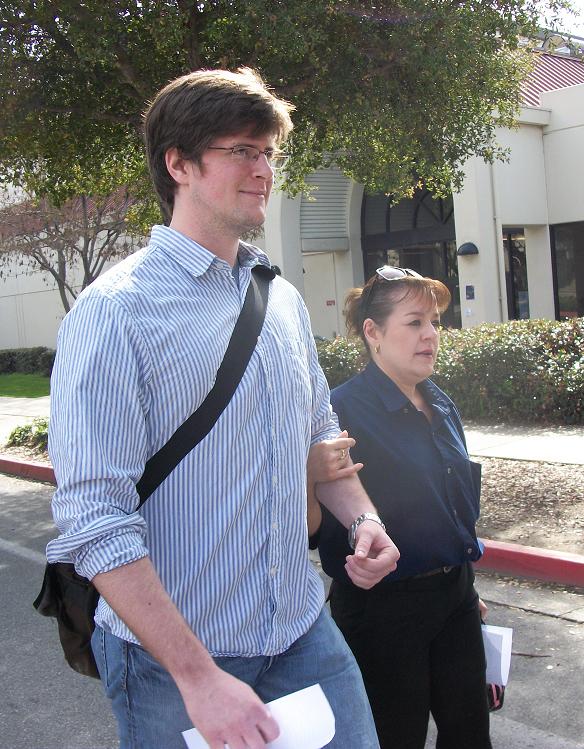
Arm-in-arm


Arm-in-arm


Students and workers unite


Arm-in-arm


Outside the administration building


Arm-in-arm


Arm-in-arm


Outside President's office


A busy man