Showing posts with label discussion. Show all posts

Saturday, March 20, 2010

Anarchy in Sierra Madre? Rebels with a Cause – Free Speech (Republished from the Sierra Madre Weekly)


anarchist picnic plus arbor day 3393
Cruz, Francesca, Kristen and Humas were just four of the small group of Anarchists who helped organize the picnic Saturday afternoon.

Photo by Terry Miller

Anarchy in Sierra Madre!

By Terry Miller

No, we’re not speaking of the highly volatile council candidate “forums” that have nearly bored residents to sleep with long winded statements many of which were transcribed from blog transmissions – that in itself is worthy of an equally long winded newspaper op-ed piece. Not all candidates are qually boring, some are simply outragous – but I digress. Back to the future…

As thousands of people began to descend on Sierra Madre this past weekend to pay homage to an old Wistaria Vine on Hermosa, a handful of young people gathered in Memorial park for what they consider a great deal more important – awareness of history and the power of the people.

With May Day approaching fast, these people who call themselves Anarchists use the holiday as a remembrance. The group recalls when the State put anarchism itself on trial. In 1886 the line was drawn and the US radicals lost their innocence.

These young individuals from all over the state of California believe Mayday is a celebration of anarchism, the history of defiance and feel that the Labor Day holiday was used as a distraction to deter citizens from the radical history of labor.

Several individuals were condemned and hanged for being anarchists in the nineteenth century: George Engle, Louis Lingg and Adolph Fisher ( according to the New York Times 11/11/1886) wrote an open letter to then Governor Oglesby refusing “any commutation of sentence short of liberty and declaring unabated faith in the principles of Anarchy.”

anarchist

Cruz, Francesca, Kristen and Humas were just four of the small group that handed out literature and held informal discussions and workshops on Saturday afternoon. Cruz thanked the Sierra Madre Weekly for accurately covering the event and its goals when another paper The Pasadena Weekly, in fact, “made a mockery” of the group’s hopes and aspirations in a recent edition.

Concerned that the police were watching this small, harmless group…it was pointed out that the Police Dept. is right next to the park so the constant appearance of police vehicles was probably due to this simple fact and not surveillance.

Anarchists make revolutions, not war: This is a proclamation on one of the handouts we received on Saturday in Memorial Park from the group that held poetry readings, music reminiscent of the 1960’s.
Ben Franklin said: ” A scoundrel’s worst fear is a society without money: for in such a society he would only get the respect he deserves.” This quote is often used in anarchist literature as anarchists use democracy – but they don’t let democracy use them.

For more information on this particular group contact their facebook page: Windchime House.
“Windchime is a collective group that hosts, supports, and creates radical events for the sake of spreading anarchism and destroying all systems of oppression.”
The group plans on meeting once a month.

http://sierramadreweekly.com

Wednesday, March 17, 2010

Democracy and Insurrection in Greece and the World (Republished from LA Indymedia)


by Rockero

Tuesday, March 9, 2010
CLAREMONT, California - Southern California got a taste of Greek-style anarchism and insurrection in a series of talks given by Peter Gelderloos, author of How Nonviolence Protects the State, and Greek comrades from the Void Network Tasos Sagris and Sissy Doutsiou. With Audio.


While centering on the recent uprisings around issues of police brutality in Greece, the talk was structured more as a dialogue or a question-and-answer session than a traditional lecture.

Peter began. "We're gonna be talking about the social insurrection in Greece, which really came to world attention after the killing on December 6, 2008 of a fifteen-year-old in Exarchia, which is sort of the counterculture and really rebellious neighborhood in Athens, in the center of Athens, that's very much associated with the anarchists. And after that there were three weeks of major rioting. After that it disappeared largely from world attention, but these social struggles are still continuing, and a lot more stronger than before December, so in a lot of ways they've won, and what we want to do is talk about where that came from, why it was possible, and then what's been happening with that, what directions it went."

He cautioned against romanticizing revolutionary images, such as the ones being projected on a wall beside the speakers, and made reference to other struggles in the UK and Barcelona, each of which occurs in a distinct cultural and political milieu.

"In this way, we don't wanna just give information bout what's going on in Greece, because that's very interesting, but ultimately, it's useless. We want to really encourage critical thinking about insurrections which will hopefully be useful to you all here for spreading rebellions here."

He then asked people to shout out questions, the first of which was a request for some historical context to the rebellion vis-à-vis its relation to the rise of anarchism and the struggle against fascism.

Tasos began his answer with an overview of the Greek movement. "There is not existing such a thing like a 'movement' in Greece because all the groups and the affinity groups and the small collectives, they are taking care of the movement, and they are the ones that are producing the analysis and the ideas and the initiatives of the movement."

He then went briefly into the two periods of the Greek anarchist movement, explaining that in both 1936 and 1967, dictatorships were imposed on Greece to contain revolutionary movements. "So, when happened the big uprising in the Polytechnic University in 1974, that was one of the main reasons that the dictatorship fall down, there participated 50, maybe 50, 60 anarchists, that they had very much influence to the general assemblies, that most of the general assemblies, they people that participated in this struggle, we have to recognize that there was leftists, autonomous leftists, libertarian Marxists, people that they had mainly Marxist, and Maoist, and Leninist influences. But the spirit of empowerment that the anarchists they gave to the struggle that took place for three, four days for the fall of the dictatorship, there was like 10,000, 15,000 people that they gathered there and that participate in these riots, it was very influential, and there it was the first time that appeared these big banners that were saying 'Down with Authority,' 'General Social Insurrection,' that was the first time that appeared the anarchist slogans and anarchist banners, inside these riots.

"Another strategy they had, it was that they appeared after '74, there appeared anarchist and autonomous groups inside the universities. These groups, they were small in the beginning, and they had little influence, but through the strong efforts, and also through the commitment and also the creativity and also the spreading of ideas, and the big publications, many free publications, that they were distributing inside the university, and also through the empowerment to the general student movement, to the students. Like the feeling that we can fight and we can win!"

This movement occupied all the universities for three months, a feat repeated in 1979, 1980, and 1985. In 1990, a large movement occupied the universities to halt their privatization, and was supported by a movement of high school students, who occupied their schools in solidarity.

"Black flags in front of the universities and of the high schools, all the universities and the high schools of the country closed for three months."

The movement not only halted the EU-imposed move toward private ownership of education, but also succeeded in establishing in the popular consciousness the idea that "the University will forever be for free, the food in the university will be for free, and the University restaurants will give food to all the poor people and all the poor immigrants and whoever is in great need that needs to have some food that day, the university restaurant has the obligation also to give free food."

The food reform was part of an effort to teach to both the political and the academic powers the "social obligation of the University." The movement itself was part of a general assault on conservatism, and had a lasting effect in that regard.

A question was asked about how communities organized themselves, and the Greek guests explained the functioning of social centers, which, among other projects, offer many free classes. Peter explained that the anarchists tend to organize in small, decentralized affinity groups. These groups have their own analyses, work on their own projects, and create their own propaganda, he explained, and share that analysis in general assemblies.

A student asked about interactions between different groups and movements. Sissy explained, "In Greece there is no monothematic campaigns. There is no separate agendas. There is no separate groups, for example, only for the immigrants, even if the immigrants by themselves have their own groups. There are many groups that each group has its own aspect and its own analysis and its own solution to the problem. All of these groups, they take care of ecology, about the student movement, about the economy, about everything."

Tasos elaborated by giving an example. "Appeared, for example, one movement influenced by the antifa groups of Germany, they called themselves also "antifa," antifascist. They have some small influence and they work very good fighting the nazis on the streets. But when they started to mobilize for demonstration, then all the anarchists made the big assembly, for a long time. 'What do we believe about the movement of antifa?' That period, the conclusion that the insurrectionary Greeks, they made, was that 'We are not antifascist. We are anarchists, and because we are anarchists, we fight against fascism. But we don't identify ourselves as separate identity of 'antifa.' Or of 'antisexist.' Or 'anti-state.' All these are parts of the anarchist struggle."

When a movement is forming, outreach is done to the entire society, not just to the affected communities. The Greeks depend less on the internet than on paper and personal outreach. This gives the movement a body, which comes back, "first through the counterinformation, then through the demonstration, and then through the riot. All of them are body. If you miss some of these parts, then you miss all. If you have just counterinformation and you don't have demonstration, then you don't exist in the public space. If you have just demonstration and you don't have riots, then you don't have political power. Nobody believes you. It's the insurrectionary body."

Part of the reason for doing so much outreach is to "spread our vision to our unknown friends, and these unknown friends are all the other people. And the unknown friends are the ones that are all the other people that they are secretly waiting for our open invitation to them, because all our events shall be open to the public," explained Sissy.

She went on to provide some more observations about the student movement, when Peter interjected, pointing to the student struggle in Barcelona. "In the years prior to this, most anarchists had the attitude that, 'The student struggle is reformist, we're not really gonna participate.' And they didn't really give it much attention. Which is an interesting perspective to think that any struggle in and of itself is reformist. I think that really shows a lack of imagination. Goals and methods can be reformist, but to pass up not only an entire struggle, but an entire section of the population, as reformist, didn't work out too well for them."

Anarchist presence within Europe's student movements was not a given, then, and neither is any particular culture more hospitable to militancy than any other, he explained, citing the ejection of anarchist defenders of a Barcelona University occupation from a demonstration led by reformist parties early in the movement.

"A lot of people in the US might be inclined to think, 'Oh, that's very easy what they do in Greece because they have a culture there of antiauthoritarianism, they have a culture of supporting violence against the police.' Spain, and Barcelona in particular, also had political cultures of fighting back. But then, within the student scene, for several years, the anarchists--they didn't pay attention to that culture, they didn't work to renew these traditions, and all that time, the political parties, the reformist political parties, were promoting reformist values, as were school administrations, and the government itself, and the economic restructuring, and all of that. So you see a very distinct cultural change here in just a decade or less of a population that is militant and that fights back, to a population that is pacifist. And the same thing could be said in the US, that generally we have a political culture of pacifism here, and who knows? In a decade, that could be gone."

The willingness of the student anarchists to enact their politics despite the lack of popularity thereof has actually won them more allies. "By showing that they are completely different from all of the politicians among the student body, are actually gaining more and more influence. Because, in the day-to-day, the politicians and people pursuing reformist tactics are gonna have all of these advantages because the system's stacked against us, but every person who actually feels this unfairness and how wrong it is to privatize the University, every person who feels this as a form of authoritarianism, and as a form of exploitation, at least on some level will identify with the people who don't act like politicians, or the people who fight back, with the people who do whatever it takes to win their freedom."

A question was posed regarding the influence of pacifism in Greece. "We don't have pacifism in Greece!" proclaimed Tasos.

The Greek perspective on violence is different. Sissy explained, "Violence is when the banks robs our everyday life through student loans, through any kind of loans. We should have this clear in our mind, what is violence or not. Violence comes from the state, and not from the people that are fighting against the injustice."

There is also an understanding that the question of violence is not one of morality, but of strategy. "We don't do it because we believe in violence. When is the moment to show the highest power? The movement knows, not the moral code. It's moralism. We are not a religion."

Another questioner asked about anarchist perspectives on movements to defend public goods that essentially fall under the auspices of the state, such as education and protections for workers, particularly in light of the corporate media's characterization of the Greek credit default as the result of a generous social safety net.

"The governors, they stole the money, you know?" responded Tasos. "And also they stole our lives. We fight to take back our lives. And also, it's a lie to believe that the public services or the free public health makes the economy worse, because what is the economy? How do we count? What we count is how much happy we are. And we are not happy at all. We are angry, you know. Even though we have free public health and free public education. Imagine how much it is, the American society?! Really, really! I mean, inside. Even if they don't understand or if they don;t believe that they need free public health for everybody. They cannot understand the concept, you know? But, we hope that slowly, slowly, they will understand. We will enforce free public health for everybody. We will enforce free public education for everybody. Nobody can prove to the society the because we have free health, the economy's no good." He continued: "What is the economy? They count their own money. We don't care about the numbers we don't care about the crisis. We are not in crisis. Anyways, Greece is in social crisis the last 30 years. Now they say it about the Euro. We don't care! We don't read the economical newspapers, you know? We don't want to understand the way that they think, in a way. We understand the way they think, but we have our own mentality. You understand? We built our own way of looking the social life."

He concluded, "the anarchists, they want much more bigger crisis than the crisis that capitalism produce right now. But this will be a crisis full of consciousness, and full of social benefit, like full of the love of social life. That the people will care each other. This will be very beneficial for all society, and this is our vision. How the anarchist movement gonna benefit the society? The society will not feel us as terrorists, or as enemies, or as problematic people, because we are not these things. We are the people that are gonna shield the society with all our possible powers. This is the vision for the economical crisis."


A few more questions/answers

Monday, March 15, 2010

Claremont University / California // We Are An Image From The Future U.S.A. Tour (Republished from Void Network)


The new anarchist / autonomist / insurrectionary youth and student movement that is taking place now in the universities of California and many other places in amerikkka is maybe the most important movement in our days in USA. Young people from many different economic, social and cultural backgrounds are coming together in their schools to fight against capitalism. In a period of economic crisis the students understand that there is not future for them, there is not any hope, the anxiety, the boredom and the wage slavery is the real face of the American Dream. The fight against the cademic elite, the corporations that control education and the every day life misery is a fight of all of us, a fight that brings together all of us.

For many hours we were speaking in the occupied room of the autonomous anarchist student group of Clearmont University. You can find some of their ideas, struggles, visions and mobilazation here:


http://afterthefallcommuniques.info/


http://occupyca.wordpress.com/


Following the links in the sites and blogs of this movement will offer you a clear idea about a very complicated movement that is starting to get stronger and stronger all over the world, the movement of the people with no hope, the youth of our times....inteligent, ecstatic, angry and wild, uncontroled young people. The people that will conquar this world soon....


http://voidnetwork.blogspot.com/

Tuesday, February 16, 2010

The Sierra Madre Anarchist Picnic (From an Organizer's Perspective)


(Editors' Note: We've received a few criticisms of the content of the articles posted on this blog as well as of the quality of the articles. We'd like to remind our dear readers that, yes, this is a blog for anarchist propaganda and will contain heavy biases toward anarchism and anarchist principles. We'd also like to suggest that if they believe the quality of the articles should be of a higher caliber, then by all means, up the bar and submit an article or nag a friend with a talent for writing to submit something. Thanks for reading!)


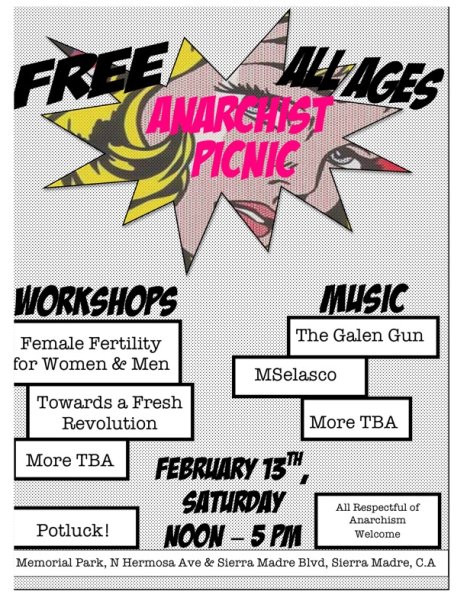
On Saturday February 13th 2010, some friends and I organized an Anarchist Picnic at Memorial Park in Sierra Madre. We scheduled the event to be from Noon to 5 PM and organized it as a potluck with a few workshops/discussions and acoustic performances.

We organized the event for a number of reasons. First, we wanted to initiate monthly anarchist events in the town where the majority of us, the organizers, live. Second, we wanted to see how many local anarchists we could bring out and discover. Third, we wanted to start building an anarchist movement in the area. And fourth, we wanted to find people that we could develop tight affinities with so we could pursue bigger and greater projects and activities. It was for all these reasons that we decided to choose the medium of an Anarchist Picnic and promote it as an event to bring together local and not-so-local anarchists and the anarcho-curious.

We (the organizers) showed up a little before noon and secured a spot in the park. We set up a table for food and a table for literature and brought some large comfortable bed sheets to lay on. We put out anarchist literature and attached a sign reading "Welcome to the Anarchist Picnic" to one of the tables . After we set up, it wasn't until 12:30 - 12:45 that a few people showed up and by the time the first workshop started, there were about seven people total.

Around 1 PM Sean, an organizer of the event, facilitated the first workshop and discussion titled "So You Think You're NOT An Anarchist?". He had designed the workshop particularly as an introduction to anarchism and for the anarcho-curious. He started the workshop by asking the attendants what their impression of anarchism was and what some of the popular stereotypes of anarchism were. One person said "When I think of anarchism I think of disorder and chaos". Another said, "To me anarchism is living a healthy sane life and seizing complete freedom while taking up full responsibility and accountability,". Participants remarked that the stereotypes and images portrayed in the media were of bomb-throwers and terrorists and Sean talked about how these images are created to make anarchism a taboo and breed ignorance.

Sean then asked participants if they identified as an anarchist and why or why not. (At this point in the discussion the number of people at the event doubled to more than a dozen.) A majority of folks identified as an anarchist saying similar statements of how, in essence, they believe in the cause of anarchism and want to see it through to fruition. However, there were a couple people who didn't. One person said, "I believe in anarchism but I won't be an anarchist until I live in a world without money or government". Another said they didn't because their impression of anarchism was of "disorder and violence". And another person declined to identify as an anarchist but affirmed that they had "anarchist tendencies".

The facilitator then asked people what they felt most bothered and coerced by in society. One person replied that they hated how, in a capitalist society, the majority of things we actually enjoy doing have no value. Someone else talked about how they felt oppressed growing up in a family embedded with capitalist values and how oppression starts at home where you learn to (mis)communicate and relate to people and the world around you. Another person commented on how they disliked the fact that boxes of food go to waste for not meeting food appearance standards like having a scratch or mark and that we have to pay for necessities like food.

After a round of answers, Sean then asked what people would like to see in their ideal society. During this question the conversation expanded onto other somewhat related topics but one participant at the beginning said they'd like to see a world where education is de-institutionalized and we learn by doing or seeing what other people are doing. Someone else said they would like to start living in their ideal society by living with close friends that are like-minded and share ideals of anarchism and from there move forward. Another talked about looking at traditional societies in the past and learning from their ways of organizing society so we can make a difference now. From here the conversation spread and went somewhat off topic with people talking about traditional societies and different examples of the ways they lived and organized. Eventually the conversation was reigned in when someone reminded everyone that many traditional societies had some form of tribal council and that a majority of them were run by males. Sean took this opportunity to conclude the conversation, announcing a 15 minute break before Bella gave her workshop/class on Female Fertility for Men & Women. At this point in time there were about twenty people engaged in the event, taking literature, sharing food, and mingling.

After the break, Bella brought out a drawing board with a sample fertility chart drawn enlarged on the board. Bella, also an organizer of the event, began her class on Female Fertility using the zine "Fertility Awareness for Non-Invasive Birth Control". Unfortunately, as she began between five to ten people left, a majority of them female, though a few people simultaneously arrived. Despite this change up, Bella went forward teaching everyone how to use a female fertility chart. She taught everything from the symbols, to what each column and table represented as well as how to check your cervical fluid, take your temperature, and check the position of your cervix. She also taught how to see where your pre-ovulatory, fertile, and post-ovulatory phase are, when your most likely to get pregnant and the four rules to guide you in your quest to get or not get pregnant.

Admittedly, the majority of people attending her class were males and while half seemed interested, the other half were fighting to stay attentive. However, the females that were present were very attentive and asked questions to clarify certain topics and learn more on the subject. As she wrapped up she let everyone know she had a box full of the "Fertility Awareness" zines for free and that the zine explained more deeply and thoroughly everything she discussed. After a couple more clarifying questions, another 15 minute break was announced and there was an exchange of some more people leaving and others coming in. At this point there were about twenty people present.

After the break, Bella and I facilitated a workshop/discussion titled "Towards a Fresh Revolution". The idea behind the workshop was to engage all the participants and brainstorm about different projects happening now in Los Angeles and that we wanted to see happen in relation to making another world possible. While doing so we would analyze the obstacles that were stopping us from making these things possible in a way to provide some type of concrete solutions so we could move forward with a "fresh" perspective. In the past we had facilitated this discussion at an Anarchist Cafe at Windchime House and the outcome was amazing.

I started by being open about the intentions and goals of the workshop and first asked the question, "What projects are happening now in LA that people feel are contributing towards making another world possible?". Food Not Bombs, Catholic Worker, Anarchy Archives, Copwatch LA, and the Hyde Park 1/2 were a couple projects and activities mentioned. In all about a dozen different projects were named. Then Bella asked "What are projects or activities you would like to see in your ideal world?". From here the discussion got a little tense as people named all sorts of different things, some of which through my own misunderstanding I felt uncomfortable putting up on the board because I didn't feel they represented my ideal world or some of the participants'. Some of the projects/activities mentioned were apprenticeships, community gardens, de-institutionalized health care, no cars, animal liberation, free public transportation, and no wifi.

After numerous activities/projects were mentioned, the next question we asked was "What are obstacles to making those projects and activities a reality?". Some of the obstacles mentioned were social stigmas, patriarchy, law enforcement, 40 hour work weeks, Obama and the spectacle of democracy, money or lack of, capitalism, institutionalized education and rent. After we came up with a whole display board full of obstacles, Bella analyzed all three of the question and answer sequences by focusing on the lack of communication between anarchists, anti-authoritarians and radicals in LA, as well as our own personal internal dynamics that have stopped us from making our wildest dreams a reality. She talked about the unspoken dress code policy, the ageism and generational gaps, and the tendencies to communicate only with those you have strong affinities with. She stressed that there's nothing wrong with having a bias towards people who agree with you but that we need to learn how to work and communicate with those who don't agree with us 100 percent and to view them as allies. After she finished speaking, a discussion was sparked where participants shared their own experiences in the anarchist movement not just in LA but all over California.

After the discussion died down, we ended the workshop with another 15 minute break followed by musical performances. There were now about twenty to twenty-five people present. The first musician to play was Jim Ramirez. He played classical guitar and had an experimental folk indie style to his music. He played four songs of resistance and revolution, the first about his struggle to find his own unique identity and culture aside from the Western American one sold to us and the last one about a fallen friend who died young but believed in revolution.

The next performer was MSelasco. He also played classical guitar but had a Spanish/Latin American folk style to his music. Almost every song he played and sang was in Spanish and related to anarchism or freedom. Some of the songs were Argentine anarchist folk songs or poems he turned into songs. For a couple of his last songs a friend of his (lover?) joined him in playing second guitar and singing, particularly for the classic songs "Bandera Negra" and "Bella Ciao".

The last performer was Dustin or The Galen Gun. He played a steel resonator guitar and his music style was of a folk blues variety. He played numerous songs, some folk and some his own all in a laid back blues style. Once he finished the event was over and folks mingled for about thirty minutes, exchanging contact information, their opinions of the event and their excitement for the next Anarchist Picnic. As people took off we packed our things and called it a day.

----------------------------------------------------------------------------------

Overall I think the event was a great start towards accomplishing the goals we set out for ourselves. I'm actually surprised there was no police interference not only because the park is in downtown Sierra Madre and RIGHT next to City Hall and the Police Department, but because Sierra Madre Police has a reputation for having almost nothing to do and instigating incidents. I'm also pleasantly surprised about the amount of local anarchists and anarcho-curious who showed up. I'm also really happy about distributing nearly one hundred pieces of anarchist literature.

To me, Sean's workshop had the most interesting dialogue going on between participants and was well suited to engage people in talking about basic anarchist topics. Bella's class was great and well-presented but I don't think it was much appreciated. I wish there would've been more females present for her class but perhaps, in hindsight, she should've saved the class for a later Anarchist Picnic. I'm glad though that people took about twenty copies of the zine she based her class off.

Regarding the "Towards a Fresh Revolution" discussion, initially I was pretty disappointed about the outcome. Compared to the way the discussion went in the past, it was pretty dull, slow, and awkward. When we facilitated the discussion at Windchime it was very fucking explosive with a whole room of people actually transforming like a vortex and talking seriously about squatting, occupying, and amazing anarchist projects. Upon further reflection, I forgot a crucial but small question to throw in and misworded the second question, while in turn relaying Bella to ask that miscommunicated question. By miswording the question, I set up a "versus" situation and tension between people's ideal worlds whereas the question should've focused on intermediate steps, projects, and activities people would like to take towards making that other world possible. Instead of a "versus" situation it would've set up an "and" situation where activities could work together. Perhaps too, like Bella's class, we should've saved this discussion for a later Anarchist Picnic when people would've known each other better and felt more comfortable to scheme about activities.

Other than that, it was pretty amazing. For putting a lot of time and energy into promoting it all over Sierra Madre, online, and in local newspapers it was well worth the effort.

On an ending note, there was some drama between us and the Pasadena Weekly and we will be having a friend write a full expose on what went down so be on the look out for that.

Till next month's Anarchist Picnic,
cruz

Friday, February 12, 2010

Another Report of 'Anarchy in Riverside' (Republished from LA Indymedia)


by Rockero

February 6, 2010
RIVERSIDE, California - Riverside-area anarchists hosted a day-long event that included a series of presentations, a group discussion, and musical performances.


While lacking the variety of last year's Anarchist Fun Faire, the event allowed local anarchists, sympathizers, and activists, most of whom were about college-aged, to convene and share ideas in the basement of the independent coffee shop Back to the Grind.

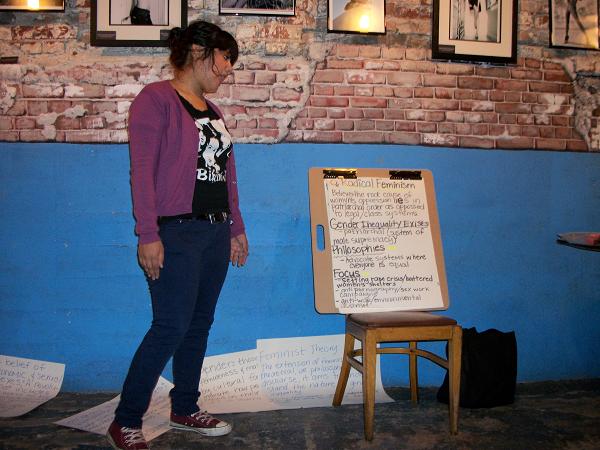
The day began with a series of talks, the first of which was given by Gloria from the Inland Empire Feminist Collective. She began with definitions of feminism, patriarchy, and gender, providing an example of patriarchy. "Feminism is the belief in the social, political, economic equality of the sexes. It is the revolutionary movement that includes those who wish the world to be equal." Or, for the less academically-inclined, she provided the definition, "Feminists are just women who don't want to be treated like shit." She then went through the various theories of feminism: liberal feminism, Marxist feminism, socialist feminism, radical feminism, multicultural/multiracial feminism (including Black feminism and Chicana feminism, to name a few), and finally, anarcha-feminism, detailing the principal tenets and focuses of each. She then handed out a worksheet for participants to fill out, with questions such as "What is Feminism to YOU?" and "How can YOU apply feminism in your life?" While we were busy pondering the questions, a young man descended the staircase, and, oblivious to what was going on, began asking questions about some literature that was on display. We explained to him that there was a workshop going on, and that he was welcome to stay and participate as long as he showed respect for the process already in progress. When he found out that the topic of discussion was feminism, he became vociferous in his opposition to the principle. He spoke loudly and interrupted others, leading some of us to suspect that he was drunk. We asked him to leave. Once attendees had finished filling out the questionnaires, a discussion was held on each of the questions posed by the worksheet. Some of the ideas brought up included the idea that the socially-constructed gender binary was just as oppressive as men as it is of women, and that people should be free to decide on their own who to perform their own gender identity. Reproductive freedom and access to womens' health services were also brought up, while some male feminists asked for advice as to how they could avoid reinforcing patriarchy when interacting with younger relatives. One man argued that the sexes are much more similar than they are different, and asked what we thought of the idea of essentialism. Following the discussion, Gloria invited us to take some flyers for upcoming events and zines on feminism.

In between talks, I spoke with one member of Riverside Food Not Bombs! who told me about recent repressive actions against anarchists by members of the Riverside Police Department. They had shut down one of the community's preferred venues, the Pharaoh's Den, and made it very difficult to reopen. They had also ticketed him for being a minor in possession of alcohol despite his not being in possession of any contraband whatsoever, and harassed other members of the collective as they attempted to do their weekly serving.

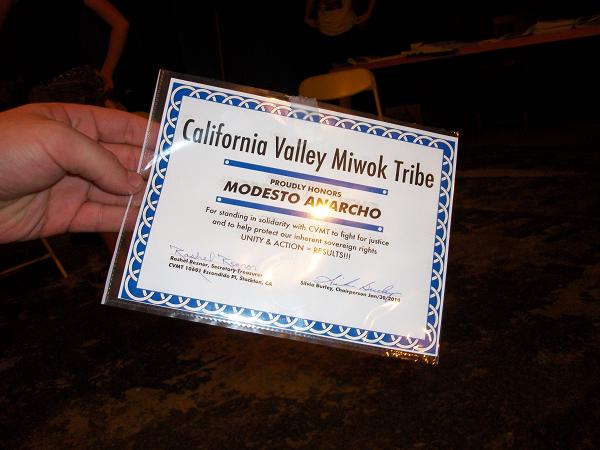
The next talk was led by Doug from Modesto Anarcho Crew, who began with an overview of the location, economy, and demographics of the Central Valley city. He continued with a description of the crew's organization and tactics. In addition to operating freeboxes, maintaining an autonomous space, and creating propaganda, they participate "in ongoing class and community struggles." "Where the fire is, we bring the gasoline," he summarized. The talk centered on what the speaker characterized as the "tension between activism and intervention." He defined "activism" as "petitioning the government or the powers that be so they can change certain things." "Intervention," "in social struggles and social tensions," on the other hand, is "trying to make those things into wider ruptures against capitalism." This tension, according to the speaker, is exemplified by the dichotomy between the "scene" that seems to exist among anarchists and the "movement" that is necessary to create a "free, non-hierarchical, autonomous society." He discussed some examples of his crew's use of "interventionist" tactics in his area, including support for a rent strike against an absentee landlord, a non-government-sanctioned needle exchange program, for which some are currently facing prosecution, and the interjection of radical strategies and ideas into the student movement. The final part of the talk centered on suggestions as to how to seek out and create allies. He talked about forming alliances with local indigenous tribes, the impoverished, and the LGBT community.

The final talk was on "anarchist infrastructure," and was given by Dana Ward from the Anarchy Archives. Before beginning, he gave an overview of the archives, and then asked us what we wanted to learn about. "I can cover everything from Godwin to the contemporary period, movements, individuals, things like that. [...] I'm a resource. Suck me as dry as you can. I'll get all the information I got in me out if I can. Just tell me what you need to know." Various requests were made: "Bonnot gang!" "Worker's cooperatives." "The origins of anarchism, especially the Paris Commune," "How to raise an anarchist army, Makhnovisti-style." "I'd like to know about the anarchist version of dual power."

He began with the Paris Commune, since the topic also touched on workers' cooperatives and expropriation. That topic led into a lengthy discussion of cooperatives, both in theory, as discussed by the anarchocommunists Kropotkin and Réclus, and in practice, such as the Spanish co-op Mondragón. A few attendees were on the edge of their seats. Others seemed bored out of their minds. Most were somewhere in between. In a brief deviation from the topic of workers' collectives, he touched on the "subculture vs. movement-building" issue. "It's not really an either/or question. [...] It's really a question of creating your scene so that you're able to sustain yourselves, where you practice mutual aid, where you engage in horizontal organization and so forth, so that when the rest of the society collapses, you already have the alternative functioning and ready to stand in its place." He then returned to the central topic, emphasizing that when both ownership and labor are collectivized, production increases and becomes more safe and efficient, before opening up for questions.

The first questioner asked if collectivization created advancements in the way industries affect the environment, women's equality, and social justice in the same way that they increased efficiency and output. Ward responded that the Argentine example provided the best answer to this question in that when factories were occupied, "the community was brought in." The next question concerned accumulation of power in the absence of government regulation. Ward's response focused on the concept of mutual aid. The next question was about horizontality and collectivization in fields outside of economics, and Ward cited the example of the Modern School.

At this point, we faced yet another interruption by a sexist asshole. "Is this some feminist bullshit? This is gay. Gay, gay, gay," he commented aloud, while Ward was attempting to answer the question. Like the previous guy, he was asked to leave. The recurrence of these types of episodes would seem to indicate one way in which we are either failing to engage potential revolutionaries or failing to prepare for probable contingencies. However, it is probably more likely a comment on the state of our society and issues such as rampant substance abuse, even among our own peers. Further questions were on law enforcement and how to deal with predators among radical communities. (He suggested shunning.)

One of the members of Modesto Anarcho challenged that idea freedom could be had simply by collectivizing the workplace. I took his challenge to mean that liberty is too large to fit only within the economic sphere, and that co-ops do not threaten capitalism per se, but it seemed that Ward interpreted the question in terms of a post-Left critique of work itself. He suggested that such critiques of "work" were rooted in the class backgrounds of the critics. "I come from a working-class background [...] To me, there's no alternative to work!" While it was framed in such a way that it was not worded as a direct attack, I could see how it could have been interpreted as such. A member of the circle broke up the debate before it threatened to consume the basement by suggesting that the topic be discussed later in smaller groups to allow everyone to participate in the conversation at hand. This intervention was fortunate, because it broke up the lecturer-questioner dichotomy to which professors, due to their professional backgrounds, are overly accustomed, whereas the comrade from Modesto was interjecting an idea in a manner meant to challenge everyone, not just the lecturer.

Following that discussion, many small conversations were had among the participants before we reconvened to discuss where to go from there. One man suggested community organizing as a tactic for movement-building. Others proposed ways to apply Modesto's "interventionist" tactic to local issues.

While I was not present for the rest of the event, the LA Anarchist Weekly reported that the Riverside Police Department refused to allow the concert to proceed as scheduled due to a 'blasphemous' representation of Christ on the event's flyer. The flyer depicted Jesus playing an accordion.


Thursday, February 11, 2010

Report-back & Analysis of 'Anarchy in Riverside' & Some Thoughts on 'Building the Party'


This past Saturday, February 6th, there was an anarchist event in Riverside titled "Anarchy in Riverside".

It was held in the basement of Back to the Grind in downtown Riverside & organized into two parts. The first part, the meeting/conference portion of the event, was scheduled to be from 12 PM to 5 PM & the fun/entertainment portion to be from 7 PM - 10 PM.

During the meeting portion, the Inland Empire Feminist Collective, Modesto Anarcho, & Dana Ward were to hold workshops & at the end there was to be a round-table discussion on "what to do next" in Riverside. During the entertainment portion, the notorious homeless jug band from Santa Cruz, Blackbird Raum, was to play as well as Corona legends, Acoustic Destroyer & some other musicians.

I arrived halfway into the workshops, catching the tail end of Modesto Anarcho & staying for Dana Ward's lecture & the round-table discussion.

While Dana Ward was preparing to speak, I remember thinking the lecture was going to be exhausting & heavily academic, but to my surprise when he began his talk on anarchist infrastructure & worker cooperatives, I warmed up to him & thoroughly enjoyed his lecture.

His lecture was not only thorough in his explanation of the history of anarchist theory on infrastructure, but he was able to drop big name anarchists in a way that was tangible & easy to understand. He also comprehensively explained anarchist & non-anarchist worker cooperatives while keeping the attention span of the room.

Towards the end of the lecture,  a debate broke out between a member of Modesto Anarcho & Dana Ward. The issue seemed to be that a member of Modesto Anarcho was concerned that anarchist worker cooperatives would create a "self-managed prison" & Dana Ward argued against that concern, claiming that wouldn't occur given everyone involved in the business would decide what happens and create an entirely different concept of what a business is. (For analysis from the Modesto Anarcho member's perspective & the ensuing debate in the comments section see: Vengeance) The ironic ending of the debate was, because of what I perceive as the Modesto Anarcho member's lack of clarity in his concern, that Dana Ward ended up questioning the class of his debater in a way that pondered whether he was from a middle class background and arguing against work itself. For those not in the know, Modesto Anarcho unabashedly represents themselves as a working class anarchist crew.

After a short break, a somewhat awkward round-table discussion was initiated in which it seemed that the facilitator of the discussion was unprepared to guide the discussion. Due to the lack of direction, the discussion never took off as participants vaguely talked about doing projects or combating local struggles. Perhaps the outcome was partly due to the lack of facilitation & direction with the discussion & also because it appeared many of the participants were strangers or acquaintances to each other. Either way it was an awkward solemn discussion.

In regards to the first two workshops, people I conversed with who were at the workshops told me Inland Empire Feminist Collective's meeting was dull & under-attended and a majority of people I talked to about the Modesto Anarcho workshop enjoyed what they brought to the table. Modesto Anarcho is well-known for critiquing anarchist projects that end up becoming another form of charity & strategizing around finding & takings sides in tensions in the community as well as using direct action & solidarity to build alliances around these tensions. (For a more detailed expose of these two workshops, once again see: Vengeance)

Though the show was planned to be at Back to the Grind, Riverside police shut down the show on the basis that the image on the flier of the accordion player from Blackbird Raum was sacrilegious in relation to Jesus.

The show was moved to a house down the street from Back to the Grind & though I didn't attend the show, a friend who did reported that the show was fun but disappointing. Disappointing because the majority of the crowd didn't attend the conference portion & appeared to be of that social clique merely following the trends of punk rock through the years without seriously involving themselves in the movement. Go figure.

Overall the event was alright. At the event I heard talk of building off this event & having continual local Riverside County anarchist events & I hope that does happen.  If so, in hindsight this event will have been a nice start to build momentum but if not, then a depressing example of an anarchist movement never begun.

We need continuous monthly or periodic anarchist serious & fun social events so that we can help build the movement. It is essential we find each other & create tight affinities so we can struggle together at school, in the workplace, & in the streets. Alienated, alone & compromising our beliefs & actions amongst people who don't & may never share our beliefs will get us nowhere. "All friendship is political".