(Editors' Note: We've received a few criticisms of the content of the articles posted on this blog as well as of the quality of the articles. We'd like to remind our dear readers that, yes, this is a blog for anarchist propaganda and will contain heavy biases toward anarchism and anarchist principles. We'd also like to suggest that if they believe the quality of the articles should be of a higher caliber, then by all means, up the bar and submit an article or nag a friend with a talent for writing to submit something. Thanks for reading!)
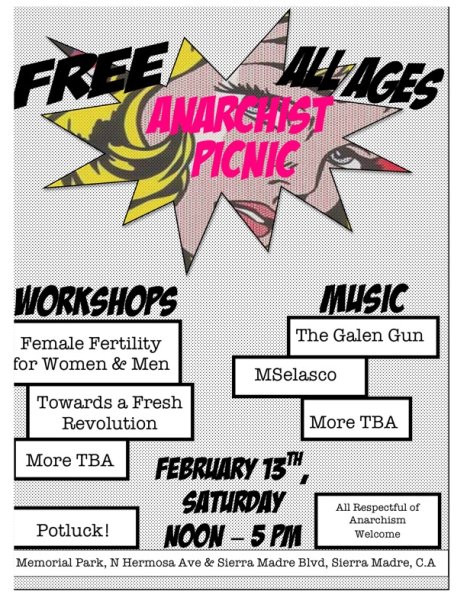
On Saturday February 13th 2010, some friends and I organized an Anarchist Picnic at Memorial Park in Sierra Madre. We scheduled the event to be from Noon to 5 PM and organized it as a potluck with a few workshops/discussions and acoustic performances.
We organized the event for a number of reasons. First, we wanted to initiate monthly anarchist events in the town where the majority of us, the organizers, live. Second, we wanted to see how many local anarchists we could bring out and discover. Third, we wanted to start building an anarchist movement in the area. And fourth, we wanted to find people that we could develop tight affinities with so we could pursue bigger and greater projects and activities. It was for all these reasons that we decided to choose the medium of an Anarchist Picnic and promote it as an event to bring together local and not-so-local anarchists and the anarcho-curious.
We (the organizers) showed up a little before noon and secured a spot in the park. We set up a table for food and a table for literature and brought some large comfortable bed sheets to lay on. We put out anarchist literature and attached a sign reading "Welcome to the Anarchist Picnic" to one of the tables . After we set up, it wasn't until 12:30 - 12:45 that a few people showed up and by the time the first workshop started, there were about seven people total.
Around 1 PM Sean, an organizer of the event, facilitated the first workshop and discussion titled "So You Think You're NOT An Anarchist?". He had designed the workshop particularly as an introduction to anarchism and for the anarcho-curious. He started the workshop by asking the attendants what their impression of anarchism was and what some of the popular stereotypes of anarchism were. One person said "When I think of anarchism I think of disorder and chaos". Another said, "To me anarchism is living a healthy sane life and seizing complete freedom while taking up full responsibility and accountability,". Participants remarked that the stereotypes and images portrayed in the media were of bomb-throwers and terrorists and Sean talked about how these images are created to make anarchism a taboo and breed ignorance.
Sean then asked participants if they identified as an anarchist and why or why not. (At this point in the discussion the number of people at the event doubled to more than a dozen.) A majority of folks identified as an anarchist saying similar statements of how, in essence, they believe in the cause of anarchism and want to see it through to fruition. However, there were a couple people who didn't. One person said, "I believe in anarchism but I won't be an anarchist until I live in a world without money or government". Another said they didn't because their impression of anarchism was of "disorder and violence". And another person declined to identify as an anarchist but affirmed that they had "anarchist tendencies".
The facilitator then asked people what they felt most bothered and coerced by in society. One person replied that they hated how, in a capitalist society, the majority of things we actually enjoy doing have no value. Someone else talked about how they felt oppressed growing up in a family embedded with capitalist values and how oppression starts at home where you learn to (mis)communicate and relate to people and the world around you. Another person commented on how they disliked the fact that boxes of food go to waste for not meeting food appearance standards like having a scratch or mark and that we have to pay for necessities like food.
After a round of answers, Sean then asked what people would like to see in their ideal society. During this question the conversation expanded onto other somewhat related topics but one participant at the beginning said they'd like to see a world where education is de-institutionalized and we learn by doing or seeing what other people are doing. Someone else said they would like to start living in their ideal society by living with close friends that are like-minded and share ideals of anarchism and from there move forward. Another talked about looking at traditional societies in the past and learning from their ways of organizing society so we can make a difference now. From here the conversation spread and went somewhat off topic with people talking about traditional societies and different examples of the ways they lived and organized. Eventually the conversation was reigned in when someone reminded everyone that many traditional societies had some form of tribal council and that a majority of them were run by males. Sean took this opportunity to conclude the conversation, announcing a 15 minute break before Bella gave her workshop/class on Female Fertility for Men & Women. At this point in time there were about twenty people engaged in the event, taking literature, sharing food, and mingling.
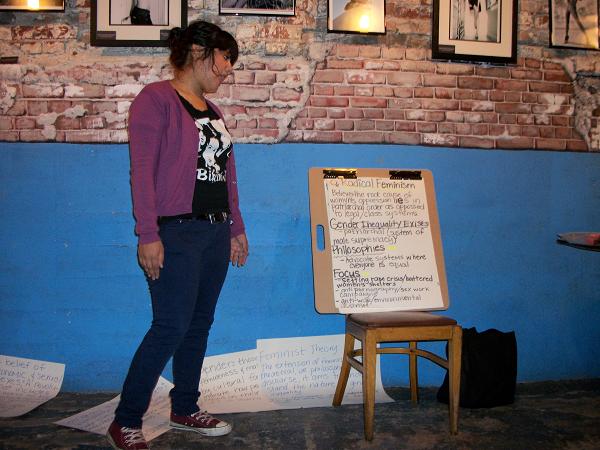
After the break, Bella brought out a drawing board with a sample fertility chart drawn enlarged on the board. Bella, also an organizer of the event, began her class on Female Fertility using the zine "
Fertility Awareness for Non-Invasive Birth Control". Unfortunately, as she began between five to ten people left, a majority of them female, though a few people simultaneously arrived. Despite this change up, Bella went forward teaching everyone how to use a female fertility chart. She taught everything from the symbols, to what each column and table represented as well as how to check your cervical fluid, take your temperature, and check the position of your cervix. She also taught how to see where your pre-ovulatory, fertile, and post-ovulatory phase are, when your most likely to get pregnant and the four rules to guide you in your quest to get or not get pregnant.
Admittedly, the majority of people attending her class were males and while half seemed interested, the other half were fighting to stay attentive. However, the females that were present were very attentive and asked questions to clarify certain topics and learn more on the subject. As she wrapped up she let everyone know she had a box full of the "Fertility Awareness" zines for free and that the zine explained more deeply and thoroughly everything she discussed. After a couple more clarifying questions, another 15 minute break was announced and there was an exchange of some more people leaving and others coming in. At this point there were about twenty people present.
After the break, Bella and I facilitated a workshop/discussion titled "Towards a Fresh Revolution". The idea behind the workshop was to engage all the participants and brainstorm about different projects happening now in Los Angeles and that we wanted to see happen in relation to making another world possible. While doing so we would analyze the obstacles that were stopping us from making these things possible in a way to provide some type of concrete solutions so we could move forward with a "fresh" perspective. In the past we had facilitated this discussion at an
Anarchist Cafe at
Windchime House and the outcome was amazing.
I started by being open about the intentions and goals of the workshop and first asked the question, "What projects are happening now in LA that people feel are contributing towards making another world possible?".
Food Not Bombs,
Catholic Worker,
Anarchy Archives,
Copwatch LA, and the
Hyde Park 1/2 were a couple projects and activities mentioned. In all about a dozen different projects were named. Then Bella asked "What are projects or activities you would like to see in your ideal world?". From here the discussion got a little tense as people named all sorts of different things, some of which through my own misunderstanding I felt uncomfortable putting up on the board because I didn't feel they represented my ideal world or some of the participants'. Some of the projects/activities mentioned were apprenticeships, community gardens, de-institutionalized health care, no cars, animal liberation, free public transportation, and no wifi.
After numerous activities/projects were mentioned, the next question we asked was "What are obstacles to making those projects and activities a reality?". Some of the obstacles mentioned were social stigmas, patriarchy, law enforcement, 40 hour work weeks, Obama and the spectacle of democracy, money or lack of, capitalism, institutionalized education and rent. After we came up with a whole display board full of obstacles, Bella analyzed all three of the question and answer sequences by focusing on the lack of communication between anarchists, anti-authoritarians and radicals in LA, as well as our own personal internal dynamics that have stopped us from making our wildest dreams a reality. She talked about the unspoken dress code policy, the ageism and generational gaps, and the tendencies to communicate only with those you have strong affinities with. She stressed that there's nothing wrong with having a bias towards people who agree with you but that we need to learn how to work and communicate with those who don't agree with us 100 percent and to view them as allies. After she finished speaking, a discussion was sparked where participants shared their own experiences in the anarchist movement not just in LA but all over California.
After the discussion died down, we ended the workshop with another 15 minute break followed by musical performances. There were now about twenty to twenty-five people present. The first musician to play was
Jim Ramirez. He played classical guitar and had an experimental folk indie style to his music. He played four songs of resistance and revolution, the first about his struggle to find his own unique identity and culture aside from the Western American one sold to us and the last one about a fallen friend who died young but believed in revolution.
The next performer was
MSelasco. He also played classical guitar but had a Spanish/Latin American folk style to his music. Almost every song he played and sang was in Spanish and related to anarchism or freedom. Some of the songs were Argentine anarchist folk songs or poems he turned into songs. For a couple of his last songs a friend of his (lover?) joined him in playing second guitar and singing, particularly for the classic songs "
Bandera Negra" and "
Bella Ciao".
The last performer was Dustin or
The Galen Gun. He played a steel resonator guitar and his music style was of a folk blues variety. He played numerous songs, some folk and some his own all in a laid back blues style. Once he finished the event was over and folks mingled for about thirty minutes, exchanging contact information, their opinions of the event and their excitement for the next Anarchist Picnic. As people took off we packed our things and called it a day.
----------------------------------------------------------------------------------
Overall I think the event was a great start towards accomplishing the goals we set out for ourselves. I'm actually surprised there was no police interference not only because the park is in downtown Sierra Madre and RIGHT next to City Hall and the Police Department, but because Sierra Madre Police has a reputation for having almost nothing to do and instigating incidents. I'm also pleasantly surprised about the amount of local anarchists and anarcho-curious who showed up. I'm also really happy about distributing nearly one hundred pieces of anarchist literature.
To me, Sean's workshop had the most interesting dialogue going on between participants and was well suited to engage people in talking about basic anarchist topics. Bella's class was great and well-presented but I don't think it was much appreciated. I wish there would've been more females present for her class but perhaps, in hindsight, she should've saved the class for a later Anarchist Picnic. I'm glad though that people took about twenty copies of the zine she based her class off.
Regarding the "Towards a Fresh Revolution" discussion, initially I was pretty disappointed about the outcome. Compared to the way the discussion went in the past, it was pretty dull, slow, and awkward. When we facilitated the discussion at Windchime it was very fucking explosive with a whole room of people actually transforming like a vortex and talking seriously about squatting, occupying, and amazing anarchist projects. Upon further reflection, I forgot a crucial but small question to throw in and misworded the second question, while in turn relaying Bella to ask that miscommunicated question. By miswording the question, I set up a "versus" situation and tension between people's ideal worlds whereas the question should've focused on intermediate steps, projects, and activities people would like to take towards making that other world possible. Instead of a "versus" situation it would've set up an "and" situation where activities could work together. Perhaps too, like Bella's class, we should've saved this discussion for a later Anarchist Picnic when people would've known each other better and felt more comfortable to scheme about activities.
Other than that, it was pretty amazing. For putting a lot of time and energy into promoting it all over Sierra Madre, online, and in local newspapers it was well worth the effort.
On an ending note, there was some drama between us and the Pasadena Weekly and we will be having a friend write a full expose on what went down so be on the look out for that.
Till next month's Anarchist Picnic,
cruz